
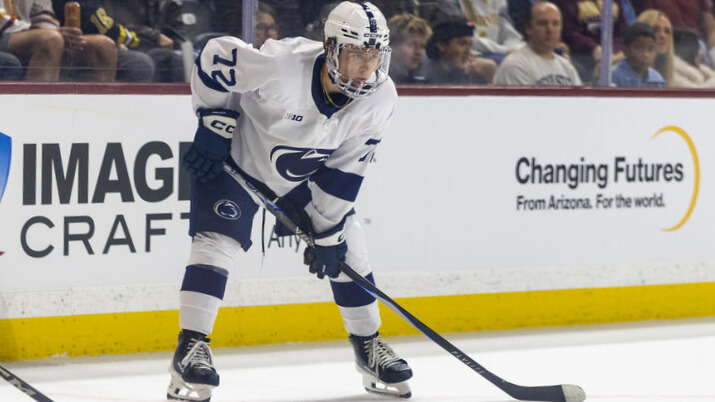
It was nearly a year ago when the NCAA instituted a new ruling that would change the trajectory of college hockey going forward. The rule allowed players with CHL experience to become eligible for NCAA hockey starting August 1st, 2025. This led to a major changes across the landscape with a trickle down effect that has impacted nearly every level and turned the recruiting world upside down. This was a year after another major NCAA rule change where players were turned into free-agents and able to move freely from school to school without having to sit out a year.
The end result of this most recent rule change has been a major boost to college hockey – their member teams now have access to the best of the best in North America. As a result they have been to recruit some of the biggest names in the game from highly touted NHL Draft prospects in Gavin McKenna (Penn State) and Keaton Verhoeff (North Dakota) from the WHL as well as recent first round selections in Porter Martone (Michigan St), Roger MacQueen (Providence), Jackson Smith (Penn State) and Cole Reschny (North Dakota). College hockey is better today than it has ever been as a result.
With that being said, what we learned from this past year was that college hockey was not at all prepared for this rule change and most staffs had never seen a CHL game let alone understood the talent pool north of the border. It was a mad scramble to accumulate as much talent as possible, starting mostly with the 20 year old age outs and then narrowing their focus for the high-end 18 and 19 year olds. This created a massive move of “de-commitments” across the multiple junior leagues in both the US and Canada which reshuffled the talent pool.
As the largest and most respected scouting platform in hockey we have watched all of these players live, many of which since they were 14-years-old and have over 10 years of data on player and recruiting class rankings so we have a unique perspective in the discussion. Now that the dust has settled and the teams are starting the 2025-26 season we go back and look at the different recruiting strategies adopted by different teams as well as a macro analysis on the impact of the CHL players on freshman recruiting.
There are 62 teams in NCAA D1 college hockey, approximately 1650 players each year who are rostered. This season 518 of those 1650 are incoming freshman which accounts for just over 31% of the total pool which is slightly higher than historical average but not significantly. However, adding in another 205 transfers which are players who are not coming in as freshman but rather transferring from other universities accounts for another 12% of the total players. That means on average, 43% of a NCAA Division 1 hockey rosters this season are made up from new players, which is significantly higher than it has been historically.
Averages can be somewhat misleading and there are outliers in the data like Miami-Ohio and RPI with new staffs and utilizing the new rules to rebuild their programs. Both of these schools are bringing in 20 new faces this season. However, three of the top leagues in college hockey NCHC, Big 10 and Hockey East have the highest number of incoming players: NCHC average is 13.33 incoming players, Hockey East is 12 and Big 10 is 10.71. There are multiple reasons why this is the case, for example the better the league the more players leave early for pro hockey and hence create more open spots for the following recruiting class. There is also the impact of the transfer portal – some schools are able to transfer easily and others, like the Ivys for example, have a much more difficult time. The overall point however is that college hockey is experiencing unprecedented turnover where teams need to recruit nearly half their roster each season from both the freshman talent pool and the transfer portal.
The question facing coaching staffs around the country is whether this was a reaction to a new rule change and things will return to their historical norms or will this only escalate with each team having a year under their belt recruiting the CHL. The answer is uncertain but the reality is that more players of higher caliber are playing college hockey – which means that more players are going to leave college hockey early for the professional ranks. This year we see record numbers of incoming players who are ranking 4.75, 4.5 and 4.25 stars in our system now that the best of Canada is eligible for NCAA. This has brought the average star rating of incoming freshman prospects up from previous years average of 3.65 to 3.88. If you isolate the top 25 in recruiting class rankings we see the average spike from 3.82 to 4.01 which is the first time it’s ever been above 4.0 in our 10 years of tracking and ranking NCAA recruiting classes.
In a three year look back for the Top 25 NCAA Recruiting Class Rankings, approximately 50% of those players came from the USHL and NTDP. The NAHL made up nearly 25% and BCHL around 20% depending on the year. If we examine this year’s Top 25 NCAA recruiting class rankings that trend has shifted dramatically; the largest feeder being the CHL accounting for 121 players or 47% of the incoming freshman class. USHL has 84 players or 32%; which is still quite an impressive number considering the CHL is a culmination of three leagues whereas the USHL is just one. The numbers fall off from there with the next highest representative being the BCHL at 22 players (8%), NAHL at 16 players (6%) and NTDP with 9 players (3%).
What was interesting about this cycle is how different teams strategized and executed their recruiting efforts. Some teams focused heavily on the transfer portal (Ferris State, RPI, Miami-Ohio, Nebraska-Omaha), while others concentrated on the CHL market (Penn State, Bowling Green, Colorado College, Michigan Tech, Quinnipiac, Maine). Not to mention the teams who brought in some former ECHL pro players this fall. Some interesting examples are the following:
The only team in the country to have players from all three CHL leagues (OHL, WHL, QMJHL) as well as 8 transfers, all of which from Canadian Universities. A few other teams took one or two transfers from Canadian Universities but nobody was even close to their eight which perfectly compliments there CHL-based freshman recruiting strategy. The players they acquired at the USport level were all standouts in the CHL and have college hockey experience playing against older, stronger competition which makes them an intriguing strategy in talent acquisition. It was a rare move and between the freshman and the Canadian transfers Nebraska Omaha brought in 16 new faces, only one of which coming out of US junior hockey. This didn’t come from out of nowhere as Associate Head Coach Dave Noel-Bernier is one of the only french-canadian coaches in college hockey and has developed a strong pipeline throughout the QMJHL and Eastern Canada as whole and Bennett Hambrook has done the same in Western Canada. Their most recent hire of former NHL Scout Jamie Huffman points to a priority the Mavericks have in a robust recruiting and scouting effort.
Ferris State
Coach Brett Riley, one of the most respected young coaches in the country, brought Long Island from a start-up program to a competitive program in short order with little resources was hired at Ferris State this summer. Given the coaching change and the new landscape, Ferris will enter the season with no true freshman on the roster. They finished 2nd in Transfer Portal Rankings with 12 transfers all from NCAA D1 coming from multiple leagues, Big 10, NCHC, ECAC, Atlantic and Independent. Brett has made a living recruiting players who are undervalued by the NCAA brass and therefore it will be interesting with a full recruiting cycle to see where Ferris State prioritizes their recruiting efforts.
Penn State
While Penn State’s freshman class is getting a lot of attention because of their high-echelon players from Gavin McKenna to Jackson Smith – the real story here is that Penn State has pivoted away from their traditional recruiting efforts and moved heavily to the CHL where they got all seven of their incoming freshmen. This is a program that has typically fallen behind the likes of Minnesota, Michigan and Michigan State in recruiting top American players out of the USHL and NTDP but now has the highest star rating average in the country for incoming freshman. Associate Head Coach Julian Pagliero is an experienced recruiter and has quietly been building relationships throughout Canada from coast to coast over the past few years and assistant Andrew Sturtz has been spotted by our staff at nearly every major event in Canada this past season. They are making major pipelines in both the CHL and Midget AAA levels throughout Canada and their recent hire of alumni Vince Pedri who had been serving as a player agent/advisor the past few years and acquired several top prospects throughout the US; an outside-the-box hire but a statement that Penn State is putting resources and value into the recruiting process. Also worth noting this hasn’t historically been a program that was younger but they brought in three 2007’s (albeit all blue chip prospects) showing they are not afraid to go younger if that’s where the talent is.
Bowling Green
Bowling Green over the past 10 years have averaged recruiting class rankings in the bottom quarter of the country yet this year they come in with a top 5 class with 11 commits, 10 of which coming from the CHL. This makes sense in that newly hired head Coach Dennis Williams was a former head coach in the CHL and Associate Head Coach Curtis Carr is a Canadian with established relationships throughout the country. They were slightly different than Penn State in that they took captains and older age out CHL players early whereas Penn State went for the younger players who were high NHL Draft prospects so they are fishing in the same waters but targeting a different type of fish. Denver has a similar set up in their assistant coach Dallas Ferguson was a head coach with Calgary Hitmen for several year in the WHL and is quite familiar and well-respected throughout the league.
Minnesota
The Gophers have always been a program that focuses on their home state and for good reason but they avoided the CHL all-together bringing in a smaller class of 6 all of which coming out of the USHL or NTDP. They complemented that with three transfers, all of which American players from other NCAA D1 programs. It appears for this year anyways they are sticking to their formula and not going off script.
St. Thomas, Northeastern, Miami (Ohio), UMass Amherst
We bunch these four programs together because they look to have adopted similar strategies in this cycle by going heavy in the USHL and sprinkling in a few CHL players who can make an immediate impact. All four of these schools have ties in the USHL, particularly Miami-Ohio where their new head coach Anthony Noreen was a longtime head coach in the USHL for Tri City so he’s quite familiar in that area. Tommy Upton, the Associate Head Coach at UMass Amherst was also a head coach in the USHL for Madison turning that program around and getting them to the Clark Cup Finals and has stayed in the USHL in his recruiting with 6 of their 8 commits coming from that league and none from the CHL. In all four cases they were able to acquire a higher end player in the USHL this past season than they have historically – partially because these programs are all on the rise and also because other schools were focused elsewhere so this strategy of staying with what they know could pay off.
Providence, Maine, Clarkson, Michigan Tech, Quinnipiac, UMass-Lowell and Colorado College
All of these programs are competitive in recruiting year-in and year-out but they’ve typically done it with older players that aren’t quite the top tier; but go on to be excellent college players who don’t dart for the NHL after a year or two. These programs all took advantage of the rule change and focused heavily in the CHL; Providence took 6 of 10 out of the CHL , Maine took 8 of their 11 out of CHL, Colorado College took 7 of 12 out of the CHL, Michigan Tech 9 out of 13 out of the CHL, Quinnipiac 7 out of 10, Clarkson 8 out of 11 out of the CHL. All of these programs, as a result, took a step forward in their recruiting class rankings from their prior three year average. They did it in different ways; Maine is one of the hardest recruiting teams in the country and were a step ahead already with their ties throughout Canada – especially in the QMJHL where they are the closest school for most teams in the league. Providence and Clarkson have always been active throughout Ontario with coaches typically in attendance for the major events at the youth levels throughout Toronto. In fact, many of their best players have come from that region historically but they made a real commitment this season as well as in Quebec. Michigan Tech, Colorado College and UMass Lowell are all unique in where they’ve gotten their talent from historically but have casted a wide net and targeted older players throughout the CHL who can come in and make an immediate impact. They didn’t waste much time with the high-flying 18 year-olds.
Cornell
Cornell has a history of zigging when others zag and are not afraid to go outside the traditional line to find players. This has typically meant for them scouting the OJHL and CCHL well and getting some under-the-radar commits out of prep schools and midget AAA who develop into contributors on their teams. This year while the attention has been on CHL and USHL; they grabbed their players from there as well but their biggest feeder league was the BCHL. They got six players out of that league where the next closest among the top 25 was three; and several teams had none and most of the teams that did have commits from there had one.
Michigan State and North Dakota
We grouped them together because they both took top echelon players from both USHL and CHL with more targeted approaches.North Dakota went WHL (4) and USHL (5) focus which makes sense given Bryn Chyzk their newly appointed General Manager was a GM in the USHL for Waterloo the past few years and is a Western Canadian who understands the WHL landscape. Michigan State is unique in that they’ve made the USHL their backbone but they’re going for high-end prospects in the CHL with Cayden Lindstrom and Porter Martone, two of the biggest commits in this cycle. Michigan State is balanced on the age front but more specifically they went after size with all 11 incoming freshman being 6 feet or taller. North Dakota is similar to Michigan State in their age balance and using USHL as their primary but grabbing blue chip prospects out of the WHL.
Boston University & Michigan
BU and Michigan continue their recruiting strategy to get the most talented players in the country primarily out of NTDP where between the two of them account for 7 of the 9 NTDP commits among the top 25 recruiting classes. Both of these programs are typically the youngest rosters in the NCAA and they don’t flinch recruiting 17 and 18 year olds to come right in and play key roles. Michigan has no 21 year old freshman and just one 20 year old freshman and BU will have no 21 year old freshman and just two 20 year olds.They play a similar style in prioritizing skilled, NHL-caliber prospects who are young but have high upside. Where they differ was in their CHL breakdown, Michigan would be closer to Michigan State and North Dakota in taking more CHL players than BU and having a focus in Ontario where four of their five CHL commits came from. They also have great ties in the USHL with associate Head Coach Rob Rassey and assistant Matt Deschamps both coming out of that league as well as assistant Kevin Reiter from the National Development program; so locking down the best in the USHL is right in their wheelhouse. BU went heavy this cycle on NTDP and only brought in one player out of the CHL.
There are others to mention of course; RPI finished first in Transfer Portal rankings and completely revamped their roster under new coach Eric Lang and Bemidji State opened the door for recruiting players out of the ECHL. So what does it all mean? If we take the top third of NCAA D1 recruiting classes we see that nearly half of the prospects are coming out of the CHL and then a third are coming out of the USHL and NTDP which leaves roughly 15% coming from elsewhere ( BCHL, NAHL, AJHL,OJHL, CCHL, MJHL, SJHL, NCDC, Europe, HS/Prep, etc). .
Having attended the CHL pre-season, the USHL Showcase and the NAHL Showcase we are already seeing the changing landscape; typically after the USHL and NAHL Showcase is a wave of commitments and CHL preseason games don’t have NCAA coaches in attendance. This year was the opposite- very few commitments after those two events and the CHL preseason was packed with NCAA coaches across all three leagues. .
The agents are the linchpin in the recruiting process in the modern NCAA landscape and speaking with them over the past few weeks in reference to their players a few common themes came up. First, NCAA verbal commitments are as fragile as they’ve ever been, which checks out considering over 100 players were decommitted or pushed back since January of this year. The second sentiment was that NCAA programs with the new roster rules, transfer portal and CHL inclusion are being patient and waiting to see how things play out over the next few weeks/months. Essentially coaches are trying to see how the CHL players adapt to the NCAA both on and off the ice and gauge their recruiting based on that. Lastly, we heard that several players who are playing in the CHL are verbally committed to an NCAA program but not publicly because they don’t want it to negatively impact their current season. The extent or number of these players is unknown by us but we heard this from multiple high profile agencies so it’s certainly not a one-off situation.
How do we see this playing out?
First off, player movement being at the level it is now where over 40% of teams rosters are being turned over each season is here to stay. Factor in that the level of college hockey is getting significantly better with the CHL inclusion that you’ll have more first and second round NHL talent that are likely to leave before graduation. Add to that the portal, which works on both ends players from players on top teams wanting more ice time and moving down the ladder and players who are excelling at mid-market or low-market teams wanting to move up the ladder. Lastly, the whole discussion around these players coming out of minor pro hockey and into the NCAA is going to open up other avenues for teams; could it apply to European pro players in certainly leagues? Overall, we think the average player movement historically being between 25-35% of the roster is going to be at least 40% and could be higher for the foreseeable future.
In terms of the product itself – college hockey is on the rise in a major way with these new changes. Opening the door to the best players in the biggest hockey market in the world is an obvious upgrade and it’s not just the top echelon players like Gavin McKenna and Keaton Verhoeff but it’s also the older players who were making their way to USport and going to the pros and now have another option at their disposal. This is a positive for college hockey not only from talent upgrades and better overall product but also from a perspective of the audience opening up the Canadian market potentially. This has a trickle down effect that could make college hockey more competitive and hopefully more parity – which has been a concern in the NIL era of college sports that the rich could get richer. With hockey being in a unique position where freshmen can be 17, 18, 19, 20 or 21 that allows the sport to have parity because historically speaking the teams with the young NHL talent have struggled to win in the post-season. Our historical data is clear that in NCAA hockey age does matter – older players typically out perform younger players and therefore a 21 year old freshman who might be a 3.75 but is going to stay for four years may very well end up being a more valuable contributor to a team than a 4.25 or even 4.5 star prospect who comes in at 18 and leaves at 19 or 20. The tickle down impact far reaches beyond just the NCAA D1 arena but makes NCAA D3 all the more competitive bringing up their level of play significantly as well as the ACHA.
From a players perspective – the good/bad debate depends entirely on the players ability. For prospects who are 4.0 stars and above in North America – they’ve never had it better. They’ll have options both north and south to develop, they’ll be eligible for NCAA if they want to take that path before going onto pro hockey. The discussion changes a bit for the 3.75 crowd who were pretty sure-fire NCAA D1 prospects a year or two ago and now some of them won’t have a home. It gets even more challenging for the 3.5 stars and below as their options are diminished with the supply and demand problem of too many players and not enough spots.
In regards to the recruiting strategy for this upcoming season; it’s a bit premature at this point to know where this is headed but the things to look for is how the CHL players perform both overall and compared to the other junior leagues (USHL, BCHL, NAHL, etc). To go a step further we will analyze how the players from the WHL perform compared to players from the QMJHL and OHL to get a more focused understanding of how that level is translating to the NCAA level. That will determine a lot on how teams attack this recruiting cycle. The next is player movement and the off-ice component. Are the CHL players staying for the full-season or are some leaving at Christmas break? Obviously the top echelon players are going to leave for the NHL at the end of the season but the real question is will the next tier players who will have a choice to sign an AHL deal or return for a prominent role at the NCAA level? The results of this will shape teams recruiting priority in figuring out the balance between prospect acquisition and player retention. Again this is a wait and see at this point and we’ll certainly be following this on our end to compare our rankings to freshman performance as we always do to find patterns and trends in the data that will shape our prioritization from a scouting coverage perspective.