
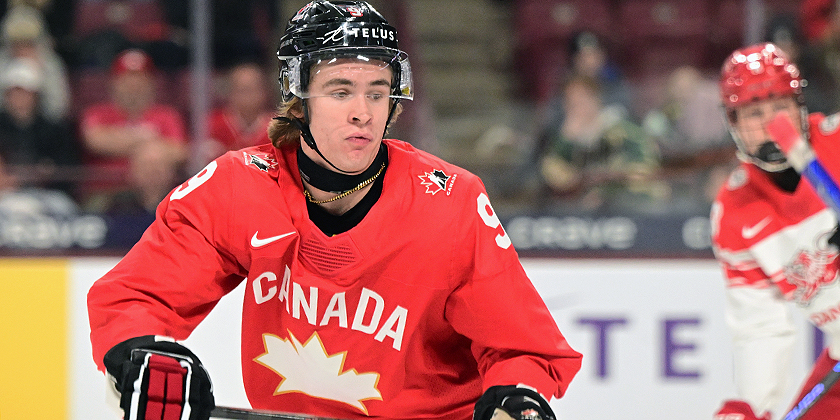
At the end of regular season play and heading into the conference playoffs college hockey coaches vote on Conference All-Star teams. Our focus here is on the All-Rookie teams and breaking down the data from all six college hockey conferences. Where did they come from? How highly were they ranked coming into college hockey? How old are they? We’ll break it all down here.
All-Rookie Team Selections in NCAA D1 Hockey (37)
| Name | Team | League | ’25 League | Age | ’25 NZ Rate |
| Jack Parsons | Providence | Hockey East | USHL | 2006 | 4 |
| Quinn Mantei | Providence | Hockey East | WHL | 2005 | 4.25 |
| Luka Radivojevic | Boston College | Hockey East | USHL | 2007 | 4.25 |
| Parker Lalonde | Merrimack | Hockey East | BCHL | 2004 | 4 |
| Giacomo Martino | Northeastern | Hockey East | USHL | 2005 | 4.25 |
| Jacob Mathieu | Northeastern | Hockey East | QMJHL | 2004 | 4.25 |
| Roger McQueen | Providence | Hockey East | WHL | 2006 | 4.5 |
| Porter Martone | Michigan St | Big 10 | OHL | 2006 | 4.75 |
| Jake Karabela | Ohio State | Big 10 | OHL | 2004 | 4 |
| Gavin McKenna | Penn State | Big 10 | WHL | 2007 | 4.75 |
| Jackson Smith | Penn State | Big 10 | WHL | 2007 | 4.75 |
| Luke Osburn | Wisconsin | Big 10 | USHL | 2006 | 4.25 |
| Jack Ivankovic | Michigan | Big 10 | OHL | 2007 | 4.25 |
| Cole Reschny | North Dakota | NCHC | WHL | 2007 | 4.5 |
| Will Zellers | North Dakota | NCHC | USHL | 2006 | 4.5 |
| David Deputy | Miami (OH) | NCHC | USHL | 2004 | 4 |
| Keaton Verhoeff | North Dakota | NCHC | WHL | 2008 | 4.75 |
| Eric Jamieson | Denver | NCHC | WHL | 2005 | 4 |
| Jan Spunar | North Dakota | NCHC | USHL | 2004 | 4 |
| Rasmus Svartstrom | St. Lawrence | ECAC | BCHL | 2005 | 4 |
| Antonin Verreault | Quinnipiac | ECAC | QMJHL | 2004 | 4.25 |
| Ethan Wyttenbach | Quinnipiac | ECAC | USHL | 2007 | 4.25 |
| Xavier Veilleux | Cornell | ECAC | USHL | 2006 | 4 |
| Thomas Klassek | RPI | ECAC | Austria U20 | 2005 | 3.75 |
| Alexis Cournoyer | Cornell | ECAC | QMJHL | 2005 | 4 |
| Zachary Wigle | RIT | Atlantic | OHL | 2004 | 3.75 |
| Evan Konyen | RIT | Atlantic | OHL | 2004 | 3.75 |
| Maxim Muranov | Niagara | Atlantic | WHL | 2004 | 3.75 |
| Francois-James Buteau | Canisius | Atlantic | QMJHL | 2004 | 3.75 |
| John Babcock | Robert Morris | Atlantic | WHL | 2004 | 3.75 |
| Lukas Swedin | Bentley | Atlantic | NAHL | 2004 | 3.75 |
| Leonid Bulgakov | Augustana | CCHA | NAHL | 2004 | 3.75 |
| Nathan Pilling | St. Thomas | CCHA | WHL | 2004 | 4.25 |
| Lucas VanVliet | St. Thomas | CCHA | USHL | 2006 | 4.25 |
| Brayden Crampton | Bowling Green | CCHA | WHL | 2004 | 4.25 |
| Hayes Hundley | St. Thomas | CCHA | USHL | 2005 | 3.75 |
| Oliver Auyeung-Ashton | Northern Michigan | CCHA | BCHL | 2005 | 3.5 |
There were 37 players selected to All-Rookie teams across six NCAA D1 conferences.
Where are the all-rookie team players coming from?
| League | # of Players | % |
| QMJHL | 4 | 10.81% |
| OHL | 5 | 13.51% |
| WHL | 11 | 29.73% |
| USHL | 11 | 29.73% |
| NAHL | 2 | 5.41% |
| BCHL | 3 | 8.11% |
| INTL | 1 | 2.70% |
Breakdown/Analysis:
The most obvious first look is that there isn’t a single player on this list who played on the NTDP U18 team last season. Historically that has been the primary producer of top talent in the NCAA Freshman pool. Recent trends are showing players going to play another year of junior after their NTDP experience where we can see from Lucas Van Vliet who played two years with NTDP before going to Dubuque Fighting Saints. Other prospects who were in consideration for NTDP were Will Zellers and Luke Osburn but neither was selected and went the USHL route.
The WHL (11) placed more players on All-Rookie teams than the QMJHL and OHL combined (9). Not only that but the WHL had the Rookie of the Year in the three top conferences with Cole Reschny (North Dakota) in NCHC, Gavin McKenna (Penn St) in Big 10 and Roger McQueen (Providence) in Hockey East. In total the CHL alumni represented 4 of the 6 Rookie of the Year winners (67%).
The CHL in its first year of eligibility with college hockey made quite a splash representing the majority of All Rookie team selections (54%). USHL tied the WHL in terms of individual leagues and still represents nearly 30% of the All Rookie team selections in the NCAA and had 2 of the 6 Rookie of the Year Winners (33%).
Age and NZ Star Rating
At Neutral Zone a star rating isn’t an indication of how the player will perform as an NCAA freshman because unlike college basketball or college football, there is a five year age difference in the age of a freshman hockey player; this year 2008 was the youngest and 2004’s were the oldest. The star rating is a breakdown of how that player compares to the others in his birth year so we lump these together to get an idea of the trends in age’s of the all-rookie players.
All-Rookie Prospects – Breakdown by Star Rating and by Age
| Age | # of Players | % |
| 2004 | 15 | 40.54% |
| 2005 | 8 | 21.62% |
| 2006 | 7 | 18.92% |
| 2007 | 6 | 16.22% |
| 2008 | 1 | 2.70% |
| NZ Rate | # of Players | % |
| 4.75 | 4 | 10.81% |
| 4.5 | 3 | 8.11% |
| 4.25 | 11 | 29.73% |
| 4 | 9 | 24.32% |
| 3.75 | 9 | 24.32% |
| 3.5 | 1 | 2.70% |
What this shows is the breakdown of star ratings among the All-Rookie prospects and then a breakdown of their ages. The data here should be taken in context to what the pool of players is. These are not the 37 best players freshman in college hockey – these are the best freshman in their leagues among the 6 different leagues in college hockey. What’s the difference? Justin Poirier out of Maine, was a 4.5 star and a 2006 birth year – he’s a top 15 NCAA freshman in the country but didn’t make the Hockey East All Rookie Team; LJ Mooney was a 4.5 star prospect and 2007 and a top 20 NCAA freshman this season but didn’t make the Big 10 All-Rookie team because he’s behind 4.75’s like Gavin McKenna and Porter Martone.
While there are six conferences in NCAA D1, there are three higher budget leagues NCHC, BIG 10 and Hockey East and then three lesser budget prorams in ECAC, CCHA and Atlantic and the data is clear that there are differences in their recruiting behavior.
| NZ Star Rate | B10, NCHC, HE | % | ECAC, CCHA, AHA | % |
| 4.75 | 4 | 21.05% | 0 | 0.00% |
| 4.5 | 3 | 15.79% | 0 | 0.00% |
| 4.25 | 6 | 31.58% | 5 | 27.78% |
| 4 | 6 | 31.58% | 3 | 16.67% |
| 3.75 | 0 | 0.00% | 9 | 50.00% |
| 3.5 | 0 | 0.00% | 1 | 5.56% |
| Age | B10, NCHC, HE | % | ECAC, CCHA, AHA | % |
| 2004 | 5 | 26.32% | 10 | 55.56% |
| 2005 | 3 | 15.79% | 5 | 27.78% |
| 2006 | 5 | 26.32% | 2 | 11.11% |
| 2007 | 5 | 26.32% | 1 | 5.56% |
| 2008 | 1 | 5.26% | 0 | 0.00% |
What the data here shows is that there are two distinct recruting strategies deployed by these conferences. The Big 10, NCHC and Hockey East are targeting higher rated prospects out of junior hockey who are younger with 57% of their All-Rookie teams being 19 years old or younger and average star rating of 4.32. The ECAC, CCHA and AHA are targeting older players with 83% of their All-Rookie team selections being 20 years old or older and have an averagee star rating of 3.92. That is a stark contrast which we can see in their recruiting patterns but certainly plays out in the All-Rookie team selections.
All Rookie Team Breakdown of Age & Star Rating
| 4.75 | 4.5 | 4.25 | 4 | 3.75 | 3.5 | |
| 2004 | 26.67% | 26.67% | 46.67% | |||
| 2005 | 25.00% | 37.50% | 25.00% | 12.50% | ||
| 2006 | 14.29% | 28.57% | 28.57% | 28.57% | ||
| 2007 | 33.33% | 16.67% | 50.00% | |||
| 2008 | 100.00% |
This chart would make logical sense in that only an elite level player (4.5-5.0 star) could play college hockey at 17 or 18 years old. The same is true in reverse as we don’t see a single 3.75-star rated player on the chart for 17, 18 and 19 year-old freshmen. That changes for the 20 and 21 year old freshman who you see somewhat the opposite, the majority is 4-star prospects and less and there are no 4.5 or 4.75 rated prospects. The highest rated 2004 recruits this season were 4.25’s because the 4.5 and 4.75s are likely already playing college and some are playing in the NHL. Keep in mind, Macklin Celebrini was the lone 5-star in the 2006 birth year and he’s already played a year of college hockey and earned the Hobey Baker, was up for NHL Rookie of the Year and won a silver medal in the Olympics and was on the All-Star team. That is what a 5-star caliber 2006 looks like which puts some of this in perspective.
CHL Influence on College Hockey – US Influence in the CHL
November 7th 2024 the NCAA changed the rule to allow CHL players to participate in the NCAA hockey for the first time. This had a trickle down effect that has fundamentally changed the recruiting strategy and the player movement across North America. The most obvious reflection of the rule change is in this year NHL Central Scouting Midterm List where you have #1 and #2 Gavin McKenna and Keaton Verhoeff from the WHL who went to NCAA hockey. Historically those two would be putting up dominant seasons in the WHL but now are able to play college hockey. For the US born players; there are four listed in the top 20 for North American skaters; none of those four are playing on the NTDP or the USHL. The top American players are all playing in the CHL – JP Hurlbert left NTDP for WHL, Chase Reid went to Soo Greyounds (OHL) out of NAHL, Brooks Rogowski went to Oshawa in OHL out of Michigan HS and Nikita Klepov went to Saginaw out of the USHL.
The question among College hockey coaches, CHL GM’s and NHL scouts has been how would the CHL players translate at the NCAA level given it’s a different style of game and it’s older, stronger, faster competition. Well the quick answer is very well; at least 7 of the top 10 teams in the country made the CHL their top focus in recruiting last cycle; Michigan (#1), North Dakota (#2), Michigan State (#3), Denver (#4), Providence (#7) and Penn State (#9), Quinnipiac (#10). We also saw teams who didn’t commit to the CHL recruiting like Boston University, Boston College and University of Minnesota who didn’t make the NCAA tournament; the first time those three collectively haven’t been in since 1970. We can also see this in the All-Rookie data where the majority of selections are coming out of the CHL where historically those would have been mostly USHL and NTDP with some BCHL and NAHL. Any talk last spring and even this fall that the player movement (CHL to NCAA and US players to CHL) was just a quick reaction to the rule change and things would settle and return to “normal” are not baring out in the data; in fact, the NCAA recruiting data would show a more significant move in the current direction.
NZ has over 100 scouts all over North America in the rinks starting at bantam age (14 years old) up through their junior hockey (20 years old) and we are seeing these patterns play out on the ground. Our scouts have observed less and less college hockey teams scouting the Midget AAA, High School / Prep School hockey this season while simultaneously seeing more and more CHL teams scouting those very markets. The priorities for both parties have shifted as the NCAA knows they now have access to a lot of the top Canadian prospects throughout the CHL and the CHL teams know they now have access to a lot of the top American youth players. Both are seeing early returns; the NCAA teams who are making the commitment to scouting the CHL are being rewarded and just this past year the CHL is seeing a wave of top US prospects in the 2009 birth year come north. These players historically would have stayed in the US and eventually matriculated through the USHL. Top 100 ranked 2009 players in the US like Drew Roscoe (Saginaw), Gavin Burcar (Spokane), Nolan Snyder (Kingston), Tyler Cooper (Erie), Finn Spehar (Portland), Ryan Kaczynski (Soo), Gerry DiCunzolo (Peterborough), Brooks DeMars (Penticton), Anthony Timmerman (Oshawa), Mark Pape (Guelph), Landon Jackman (Owen Sound), Mason Courville (Flint) and Luke Johnson (Brampton), Paulo Gualberto (Halifax) to name a few have all made the move north.
Our Next Analysis:
The All-Rookie teams is a small sample size and only a snapshot of what is going on in the college hockey landscape so we’d like to do a follow up study of all the NCAA freshman, where they came from, what their rating was, how many games played, minutes played and other statistical measurements to get a sense for patterns. That would give a more complete picture – especially in regards to player performance out of particular leagues and also in regards to star ratings and age of freshman.
We will also do a separate study on the transfer portal and those returns. We’ll look at all-conference players like we did here for first and second teams and see who were the transfers and then we’ll do an aggregate of all the transfers, their age, their star ratings and their performance on their new teams. We’ll track how certain leagues, for example, a standout in the AHA or CCHA – how did they perform in aggregate in the NCHC and Big 10 and how did players from top rated teams perform when they went to smaller market teams for more opportunity. We’ll break that down to better understand the successes and failures of that system.
Photo Credit: Dan Hickling/Hickling Images