
Every draft is unique; there are different players, there are different storylines and teams looking for different attributes. We saw after the Chicago Blackhawks Stanley Cups that there was a shift towards skill and pace; after St. Louis and Florida Panthers won the Cup we saw a return to bigger, stronger prospects who are built to make long runs in a physically demanding NHL playoff.
While this draft is just one year and one data point, there are potential ripple effects that could change the landscape of amateur hockey in North America. Obviously, the rule change last year, which allowed CHL players to compete in NCAA for the first time, is the main catalyst of the changing landscape in amateur hockey in North America but some of the impacts are already showing in the final rankings of the 2026 NHL Central Scouting Final Rankings, which list the best prospects available for the upcoming NHL Draft. Drafts not only have consequences for which players teams select, but they also serve as signals to players, agents, and coaches about where the market is heading. Where are NHL clubs allocating their time and resources, and where are they seeing the most value in their scouting efforts?
Analyzing the NHL Central Scouting Final Rankings North American Skaters list, there are several new trends that we will dive into.
- The rise of the GOHL – ever since the OHL has made an official partnership with the GOJHL and changed the name to the GOHL – there has been a spike in talent in that league. The league got younger and more skilled, and OHL clubs felt more comfortable sending their players there to develop before making the jump to the CHL. The impact? Three players from their league are listed in NHL Central Scouting Final List. That is more than the OJHL, CCHL, AJHL, SJHL, MJHL and BCHL combined! Nobody, not even the OHL would have been able to anticipate that going into this season.
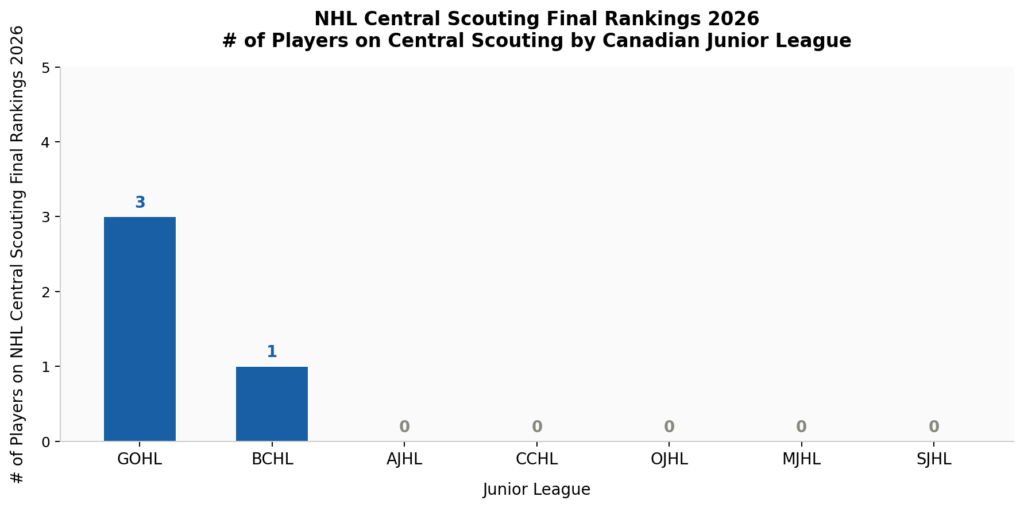
Besides the success of the GOHL in its inaugural season, it is also true that the Canadian Junior leagues are not generating the same kind of NHL Draft talent they have in the past. That is not to say they aren’t getting any and it’s also not to say they are not good leagues; keep in mind Caleb Malhotra and Jack Pridham, two of the best forwards in the OHL this season, were in the BCHL the year prior. With that being said, the NCAA/CHL rule changes opened the door for those players to now go to the CHL, so the likelihood of the BCHL landing the Tyson Josts and Bradley Nadeau’s is unlikely going forward.
- The top two non-CHL junior leagues in North America have been BCHL and USHL and both have taken a major step back in the NHL Draft prospects after the CHL/NCAA rule change. High School prospects, which include Minnesota HS, New England Prep, Ontario Preps like St. Andrews, and Minnesota’s Shattuck St. Mary’s, have also seen a pullback this year.
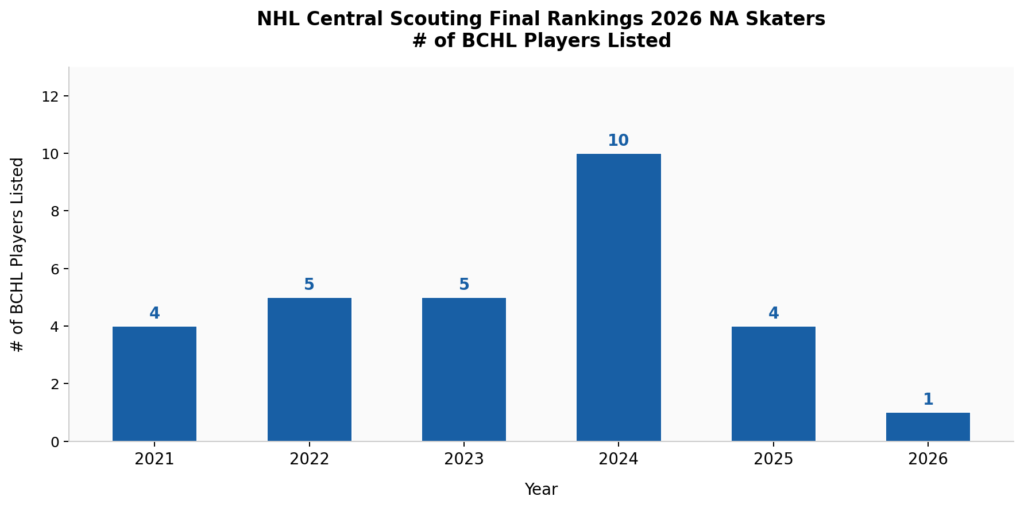
The BCHL has some unique circumstances that could explain these numbers: it absorbed most of the top teams in the AJHL in 2024 and broke away from Hockey Canada to form an independent league. With that being said, the BCHL was the best junior league for top-tier Canadian junior players (and some Americans) interested in the NCAA route, but now that they can still achieve that through the CHL, they can’t recruit the same level of talent.
The USHL, while a better league at the top end and in overall depth, has also seen a considerable drop in on-ice performance, as demonstrated by NHL Central Scouting’s List (and also in NCAA commitment data).
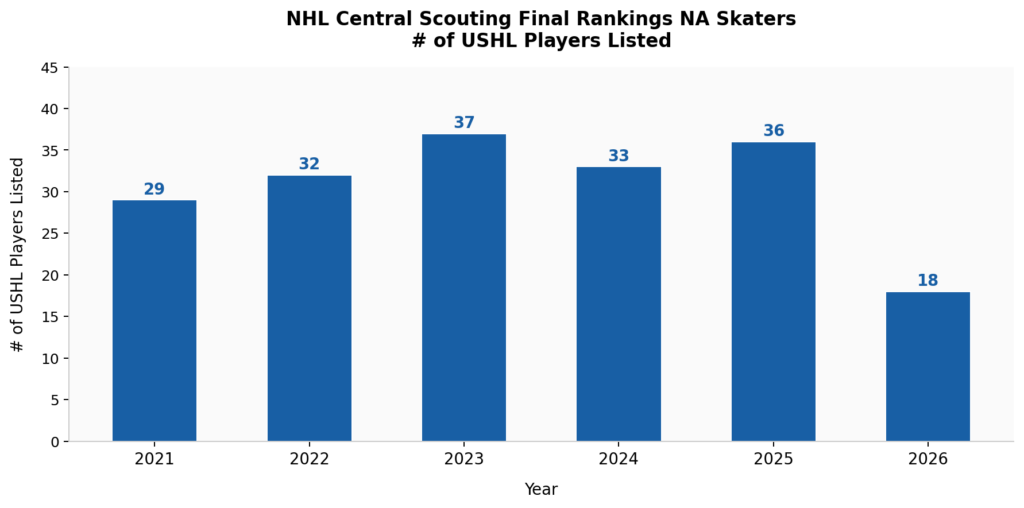
The USHL data shows a consistent stream of about 29-37 players listed on Central Scouting over a five-year period, only to see that average cut in half in 2026. The results here are a bit more complex because, in fairness to the USHL, there are several higher-end players like Nikita Klepov, Egor Barabanov, Cooper Dennis, and Adam Benak who were in the USHL a year prior but moved up to the OHL for the 2025-26 season. In fact, over 50 players left the USHL in 2025-26 for the CHL. There are others like Tynan Lawrence, who spent most of the year with Muskegon but ultimately ended up at Boston University. With that said, the USHL’s best NHL Draft prospects in the past five years have been Canadian or Europeans in the likes of Owen Power, Adam Fantilli, Macklin Celebrini, and Artyom Levshunov. Since the rule change, those efforts have become a far greater challenge to place Canadians in the USHL, and are among several reasons for a drop in on-ice performance. This doesn’t appear to be a one-off, as the top rookie in the USHL this past season, James Scanttlebury, just signed with Quebec Remparts in the QMJHL, and Gavin Katz, out of Green Bay, signed with Penticton, with more to come in the following weeks.
We see it also in Europeans like Benak and Barabanov as an example, who came to the league for one season before their CHL Import Draft year and then matriculated to the CHL the following season for their NHL Draft year. The other component here that is working against the USHL is top Americans are also leaving the US to play in the CHL such as top ‘09 US prospects like Gavin Burcar (WHL), Brooks DeMars (WHL), Finn Spehar (WHL), Nolan Snyder (OHL), Tyler Cooper (OHL), Ryan Kaczynski (OHL), Gerry DiCunzolo (OHL), Landon Jackman (OHL), Mark Pape (OHL), Anthony Timmerman (OHL), Patrick Ula (OHL), Drew Roscoe (OHL) and Cameron Minella (OHL) to name a few. These players would have historically matriculated to the USHL. The American 2010’s this USHL/CHL draft cycle heading north are even more pronounced, both in totals, especially at the top end of the talent pool.
Also, high school hockey has seen its numbers drop a bit over the past few seasons, reaching a low in this 2026 NHL Draft Class.
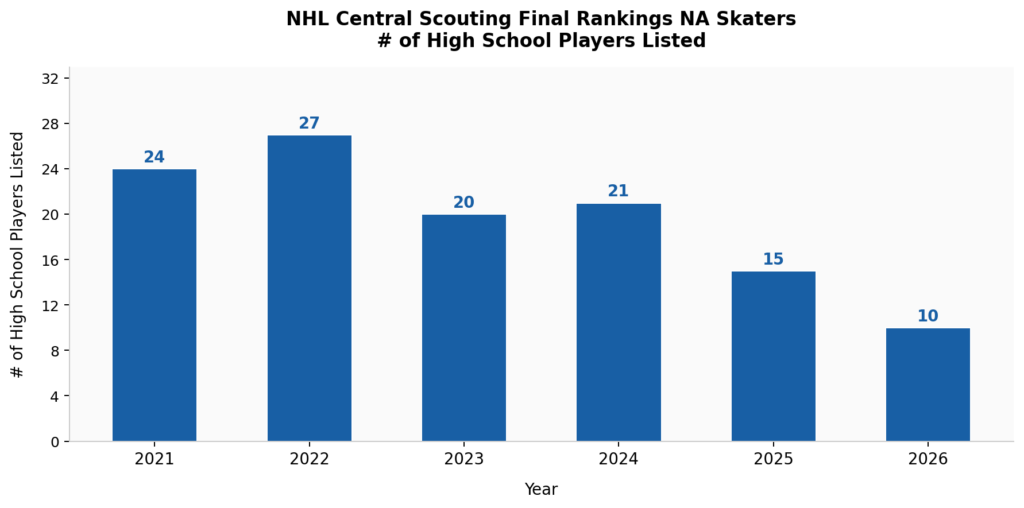
There has been a somewhat gradual decline in the number of high school hockey players listed on Central over the last few years. This can be attributed to multiple factors: high school hockey has lost some of its core depth as players leave earlier for juniors, making prospects’ performance at that level less reliable in the eyes of NHL scouts. The CHL is a new opportunity that didn’t exist prior, and some players are taking advantage. These player movements, especially BCHL and USHL to the CHL, open up spots that didn’t otherwise exist for players in those leagues. As a result, a player who three years ago wouldn’t have been ready to play in the BCHL or USHL at 16 or 17 years old, and who was playing high school, is now getting recruited by those leagues and is in a position to make those teams. The prospect pool at that level is already fragile so players leaving early is tough for these areas to overcome.
- College Hockey is on the rise. While we have seen the likes of Jack Eichel and Macklin Celebrini playing in the NCAA during their NHL Draft years, they were the outliers. This year, we saw a spike in NCAA players in the NHL Central Scouting List.
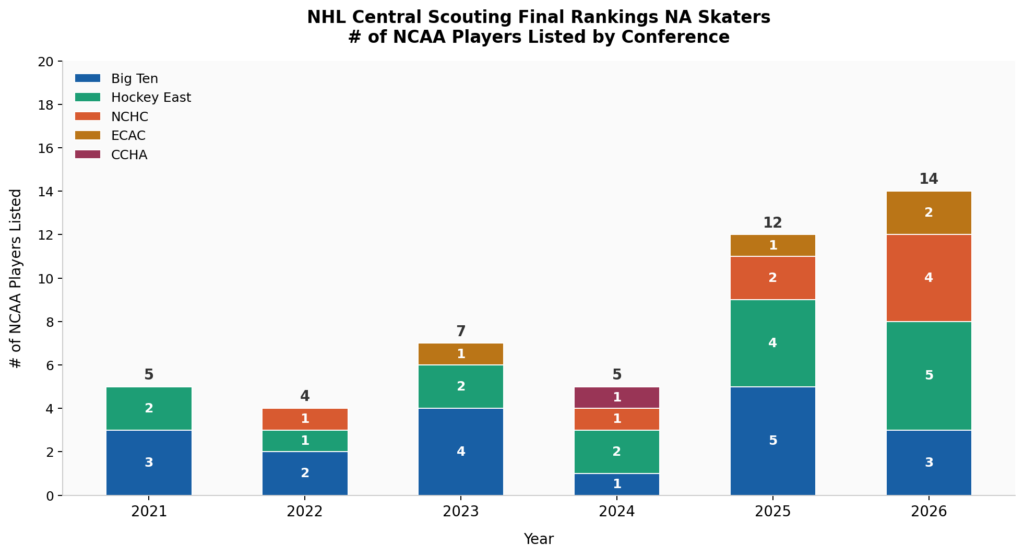
From 2021 to 2024, NCAA hockey churned out about 4-7 players on NHL Central Scouting, which has more than doubled over the past two seasons. Analyzing current recruiting patterns, there doesn’t seem to be any slowing down. The Big 10 and Hockey East have always been involved in recruiting young, talented prospects who can come in and contribute at 18 years old, but now the NCHC is getting more and more involved, and even some ECAC teams are getting involved here.
The 2026 NHL Draft
Given that the majority of NHL players who have a career in the NHL, defined by 250 games or more, were drafted in the top two rounds of the NHL Draft, we’ll focus our study on the top 64 North American skaters list prospects on NHL Central Scouting. Europeans and goaltenders are selected as well, which will push likely 15-20 of these players outside of the top two rounds when it’s all said and done, but we can assume for the sake of this study that those players are in the discussion for second-round selections.
In this graph, we look at the total number of players from the respective leagues in Central Scouting and how many of those players are potential top-2-round prospects.
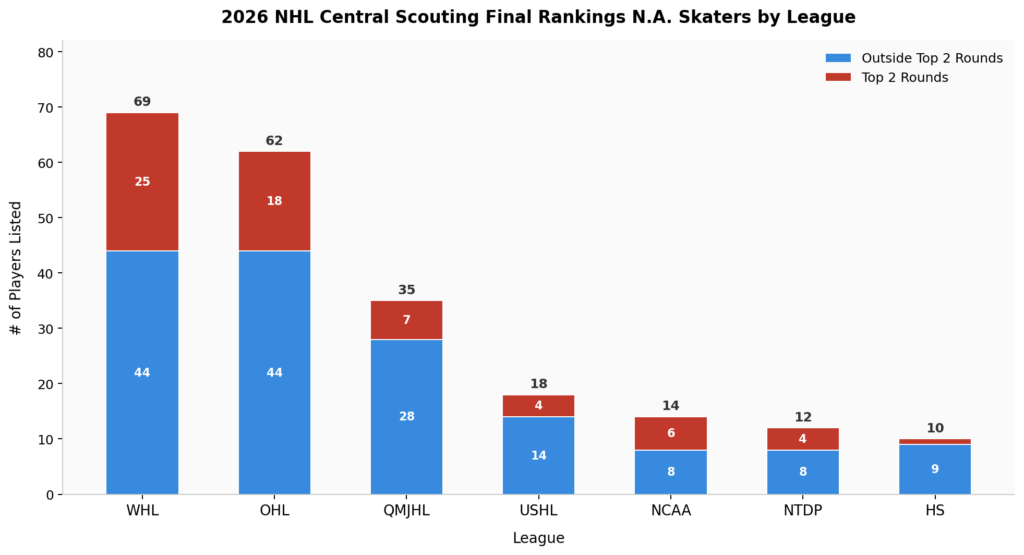
There is a lot to learn from this graph, and we’ll analyze each element.
The CHL, as a whole, is the three biggest sources of NHL Draft talent; they combine for nearly 75% of the North American Skaters list. Even more impressive is that they represent 78% of the top two-round caliber prospects. While that isn’t necessarily news to anyone who has been following the NHL Draft, it is a reflection that, while the CHL faces its own obstacles, such as players leaving early for NCAA or NHL opportunities, it remains the dominant source of developing 17/18-year-old prospects for the NHL Draft.
The NCAA has 14 players on this list, which is high for Central Scouting, and six of them (43%) are given a top-2 round grade. This is the highest percentage of all the leagues listed, which demonstrates the respect NHL clubs have for the college hockey game and the difficulty of playing at 17/18 years old.
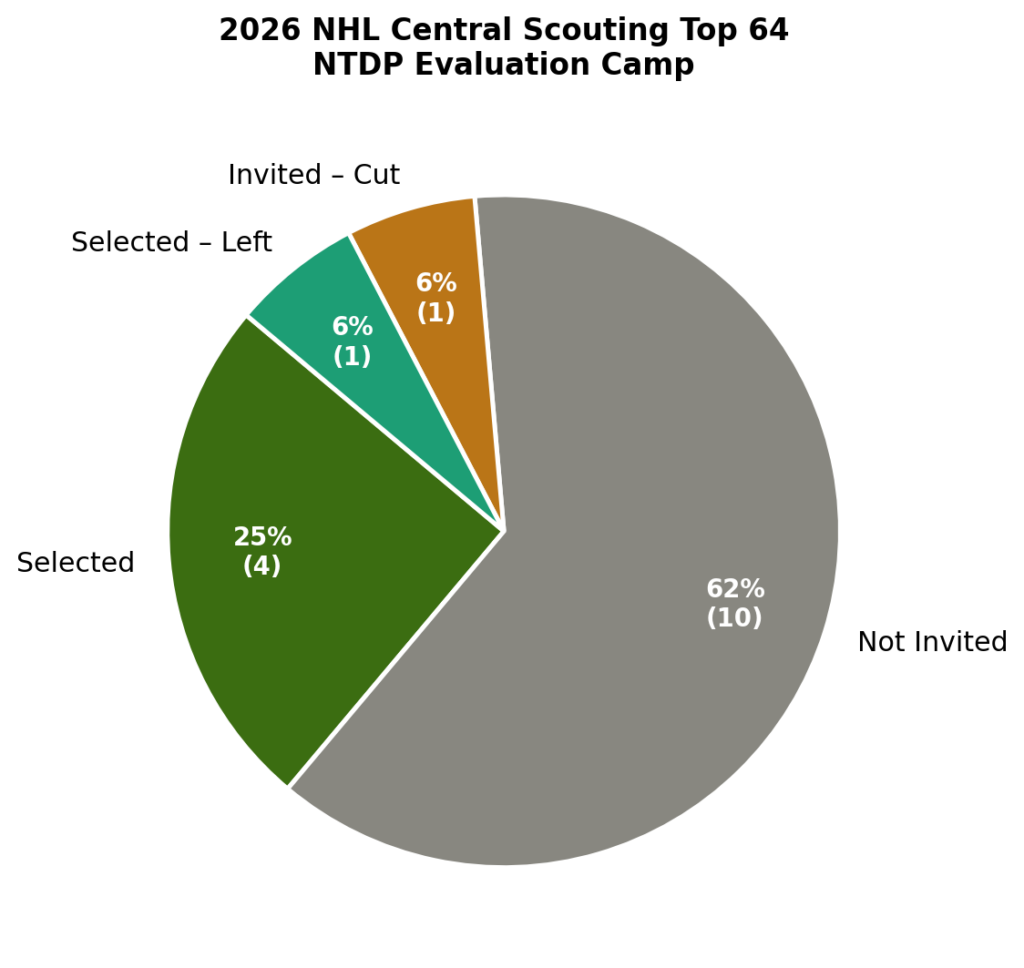
While it’s not entirely fair to put the NTDP up against actual leagues with 20+ teams, they are a standalone in that they don’t have to go through the draft process and can select anyone born in the USA. The NTDP could be combined with the USHL, but that’s not entirely fair either, since they don’t draft, they don’t participate in U18 playoffs, and they don’t play a full USHL schedule. Either way, the NTDP has only 12 players listed on Central Scouting in this year’s draft, and only four are listed in the top two rounds; that is a notable drop-off from prior history. Even combined with the USHL, they would still be below the QMJHL and less than half of the WHL or OHL in players in this draft class.
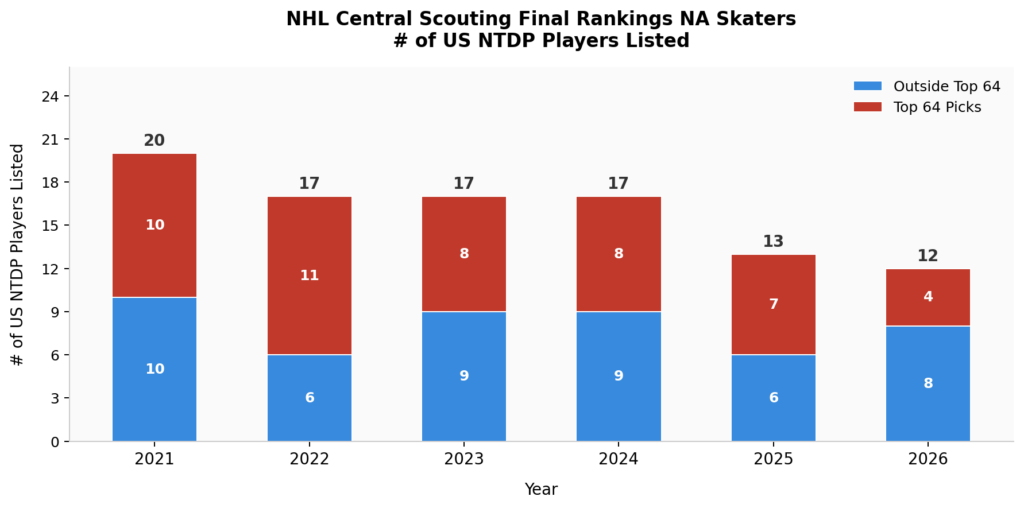
The NTDP has some advantages in its ability to select players in any region in the US before their CHL or USHL drafts. They also have the backing of the NHL, so they get excellent training on and off the ice, quality coaching, and development opportunities. With that said, they also have detractors; they are in a bubble around kids their age, without the kind of 19- and 20-year-old veteran leader in the locker room to show them the ropes. They don’t have a home crowd to speak of and aren’t in pressure situations to win and make the playoffs, or in those kinds of environments, on a consistent basis.
Last year, JP Hurlbert, who was arguably the US’s best player throughout the year on the U17 team, did not return for his U18 season. Instead, he went to the WHL, where his game has flourished and is projected as a first-round NHL Draft pick. In fact, NHL Central Scouting has him ranked one spot higher than NTDP’s top-ranked prospect in Wyatt Cullen.
This is significant not only in the story but also in its impact, as the player left what is considered to be the best development path for American prospects for the CHL, which was a gamble and looks to be paying serious dividends. It would be one thing if NTDP lost a player who wasn’t getting enough ice time but to lose their top prospect after the 17’s year set a precedent that is likely going to be followed this upcoming season. Neutral Zone avoids the rumor mill but all spring the world around rinks across the country has been NTDP could be facing as high as eight departures from the U17s this off-season. That number is probably an over-exaggeration, as we’d heard up to 4 players were looking last year, only for one to ultimately leave. Some of that rumor mill could be CHL propaganda as they vigorously compete for top American prospects, but the fact is JP Hurlbert is not going to be the last to jump from NTDP. Recent trends are working against the NTDP, and having just four players in the top two rounds is not a ringing endorsement to keep the next JP Hurlbert from leaving.
While scouting the Minnesota Top 68 Camp a few weeks back, the excuse around the rinks regarding USA’s representation on Central Scouting was that this NHL Draft was a “weak draft year for Americans.” So we looked at the last five years of data: on average, roughly 19-20 Americans have been listed in the top two rounds, and this year it is only 16, so it’s a bit off the average mark, suggesting a potentially weaker draft class. With that in mind, of the 16 players listed by Central Scouting as Top 2 round considerations, only four of them were on NTDP, with a fifth being an NTDP Alumni (Landon Hafele). This is arguably the best example of the changing landscape: five of the top six American prospects for this year’s NHL Draft are coming out of the CHL.
| CSR N.A. Rank | Name | Team | League |
| 2 | Chase Reid | Sault Ste. Marie | OHL |
| 8 | Nikita Klepov | Saginaw | OHL |
| 12 | JP Hurlbert | Kamloops | WHL |
| 13 | Wyatt Cullen | USA U-18 | NTDP |
| 17 | Tommy Bleyl | Moncton | QMJHL |
| 21 | Brooks Rogowski | Oshawa | OHL |
| 24 | Casey Mutryn | USA U-18 | NTDP |
| 34 | Jack Hextall | Youngstown | USHL |
| 37 | Tyus Sparks | Spokane | WHL |
| 42 | Victor Plante | USA U-18 | NTDP |
| 48 | Timofei Runtso | Victoria | WHL |
| 51 | Blake Zielinski | Des Moines | USHL |
| 55 | Landon Nycz | UMass | Hockey East |
| 61 | Jayden Kurtz | Rogers | High-MN |
| 63 | Rian Chudzinski | Moncton | QMJHL |
| 64 | Landon Hafele | Green Bay | USHL |
This trend is an anomaly when looking back at the last ten years of NHL Central Scouting data, where most of the top US players typically come out of NTDP and USHL, with an occasional MN High School player. That trend has changed dramatically over the past year due to the rule change. It’s also worth noting that we are not suggesting that all of these players had the option to play on the NTDP, as Hurlbert did, and chose the CHL instead. In fact – the majority of these players were not even invited to either the 2023 or 2024 NTDP Evaluation Camps and never had a choice to begin with. We are simply pointing out the change in landscape in just one year since the rule change that the NTDP and USHL no longer are the preferred pathway to the NHL Draft for American-born players, at least not for the 2026 NHL Draft.
What does it all mean? What can we expect from 2027 and beyond?
This is the real question: is the 2026 NHL Draft an anomaly or a one-off, or will the data we are seeing in the 2025-26 season translate to future NHL Drafts in 2027, 2028, and beyond?
Neutral Zone has over 120 scouts stationed across North America in rinks, giving us a unique perspective with feedback and hands-on experience in every corner of every hockey market in North America. We have close relationships with every level of the game, from NHL scouts to NCAA coaches to NHL agents to CHL GMs and scouts to USHL GMs and scouts to youth hockey, AAA, high school, prep school, etc. While we certainly cannot predict the future and don’t intend to even try, we can provide insights into what we are seeing and hearing in the rinks.
There have been some changes in the youth landscape and the high school and prep levels, but overall, the 15-and-under-level hockey has remained relatively the same across the US and Canada, at least for the past three years. The changes are mostly happening at the 16 and beyond – where players are being more heavily scouted by CHL/USHL, NCAA and NHL.
Currently, the CHL is fighting battles on two fronts, and while it is the dominant destination for top Canadian prospects, it also has to recruit and sign Europeans and Americans. These are battles they are, in large part, winning over NTDP, USHL, and BCHL; however, when those players succeed at the CHL level, they immediately become targets for both the NCAA and NHL. The job is only going to get harder in the coming year because NCAA coaches have seen the success CHL freshmen have had in college hockey and are becoming more aggressive and allocating more resources to CHL recruiting. They are also going to be challenged by the NHL, which is now allowing 18-19-year-old draft picks to play in the AHL instead of going directly to the NHL. Some in the league are arguing that there is considerable overlap in the players who would leave for the AHL and the same players who are leaving for NCAA, but that remains to be seen. The CHL has proven they have a robust talent acquisition machine, drawing not only the top Canadian players but also Americans and Europeans, but will need to continue their efforts on retaining the talent they acquire.
For the USHL and NTDP – they’ve taken a hit with the rule changes. The USHL can’t compete for Canadian-born players outside of Youngstown and Muskegon who can pay, and the NTDP is losing its top players. In fact, Muskegon has even tried to land some of NTDP’s top targets the past few years with significant financial offers for their top prospects so it’s not just the CHL circling the wagon. This year, in the 2010s, the NTDP program didn’t even have the chance to sign two of its better prospects, as they were already signed in the WHL, Easton Dozark and Ezekiel Kaebel. The 2010’s on NTDP will have two high-level players they’ve been longing for: Joey Cullen and Drew Daley, both potential top-10 NHL picks in 2028. The rest of the team, however, is lacking true star power and size, which could lead to continued low overall numbers in the 2028 NHL Draft. The 2027 draft will largely depend on who returns to the NTDP next season and who leaves for the CHL. The top prospect on that team – by quite a margin – is Carter Meyer, who has a brother at Quebec Remparts who also owns his rights. If Carter leaves, that will be the second year in a row that the NTDP couldn’t retain its top prospect. After Meyer and maybe Nolan Fitzhenry, it gets blurry when looking for first-round NHL talent on the NTDP 17s. The USHL has a slightly different problem, as the league was never really a top-two-round NHL Draft league, but made its living developing later bloomers in the middle and late rounds. That will likely be their strategy going forward with the changing landscape, but after losing players to the NTDP and seeing top Americans sign in the CHL, there isn’t much left over in terms of NHL-caliber prospects. For 2027, they’ll likely start the year with two legit 2009s in Gunnar Conboy (Green Bay) and Trevor Shorter (Chicago Steel), but Shorter is a late-birth-year player and won’t be eligible until the 2028 NHL Draft. Oliver Ozogany will get attention in the CHL Import Draft – holding onto him will be a priority for the league, and others like Brody Berard, Caleb Deanovich, and Jake Prunty are needed to boost the league’s NHL Draft profile. This most recent USHL Draft told us, directionally, a lot about where the league is prioritizing: they are ditching Canada, focusing on key US markets they feel have advantages, doubling down on Minnesota, and getting more aggressive in Europe.
The USHL lost 50 players to the CHL this past season and will need to reduce that number this offseason to maintain the talent they have. One initiative to help is the league adopting standard player agreements, under which CHL clubs would pay a transfer fee to the USHL club to take their players (in the ballpark of $50,000). The agreements are a retention strategy, but whether they will be helpful as an acquisition strategy is a whole other question. We saw a massive spike in Americans making the jump to the CHL last year – a trend we believe continues in 2026-27 from what we are seeing on the ground.
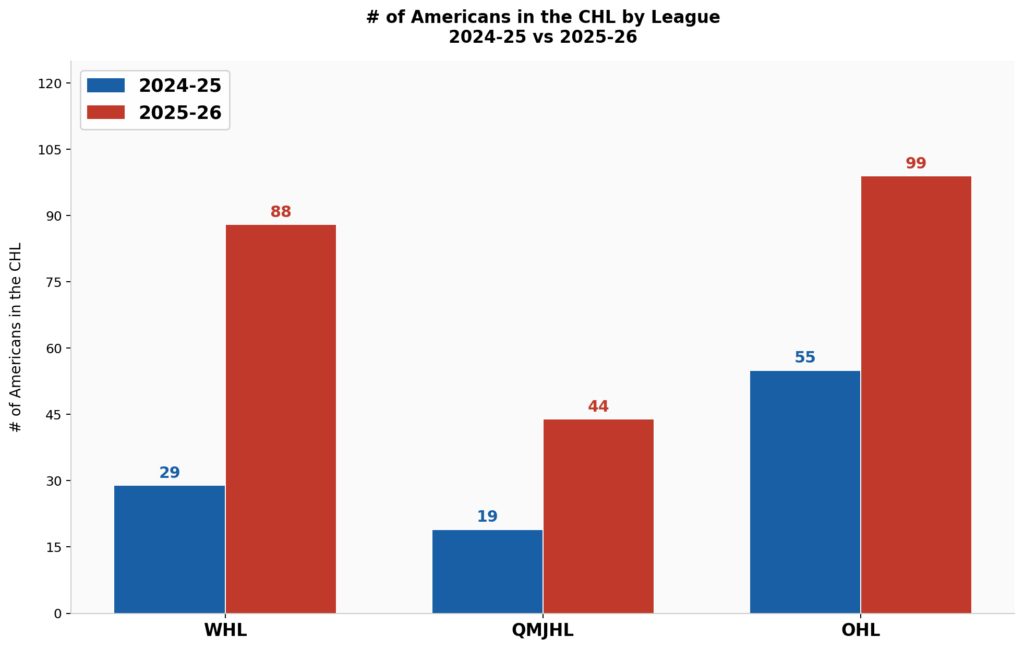
This analysis by the Dan K Show shows the trend from the 2024-25 season to the 2025-26 season of Americans entering the CHL; it has more than doubled, from 100 players in 24-25 to 217 in 25-26. While we don’t anticipate another 2x jump, as there aren’t enough spots, we do believe there will be an increase not only in the aggregate but also in each league. We see the WHL approaching or surpassing 100 Americans, the QMJHL passing 60, and the OHL closing in on 125.
However, the CHL will lose more players in 2026-27 than it did the year prior. According to College Hockey Inc, which tracks all NCAA D1 commitments, there are 274 CHL players committed to NCAA college hockey next season. That is a moving target, admittedly, given NHL signings, NCAA transfer portal, etc., as players are constantly being pushed back or committing to other schools, but that’s the available data currently. Last year, there were 150 freshmen in the NCAA from the CHL; if this number holds for 2026-27, that would be an 83% increase. Looking at some of the names and the expected arrival date, we believe that number will be lower than 274, but it will still be a major shift towards CHL in NCAA D1 recruiting for the 26-27 season.
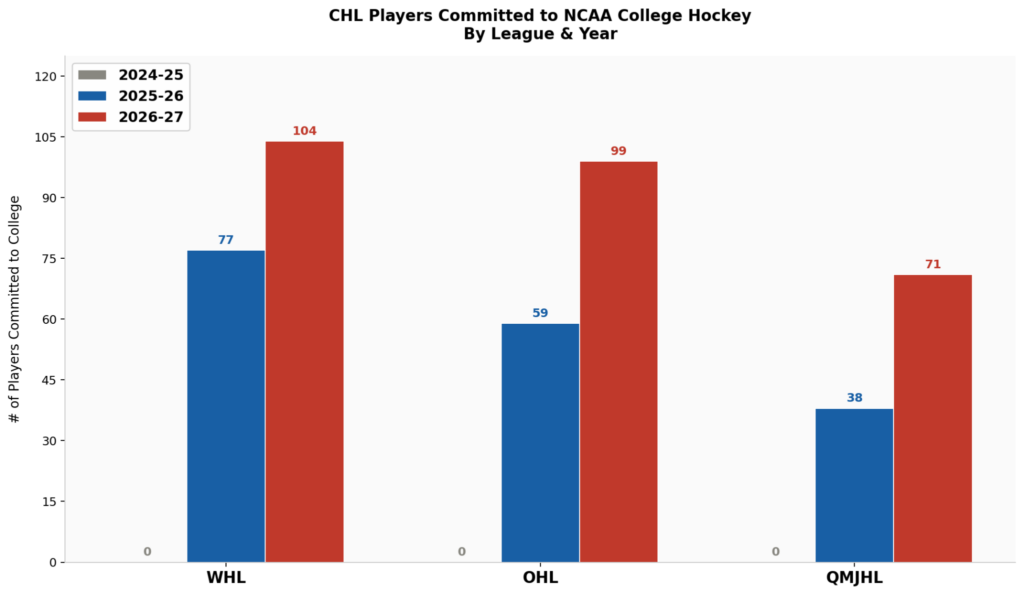
NCAA programs may have significant resources, but they have limited staffing, and they can only see so many players. The shift we are seeing in the numbers matches what we are seeing at the rinks where NCAA coaches are allocating much less resources to the 15 and 16-year-old prospects than they did in years past. They are also less prevalent at junior hockey games and tournaments outside of the USHL and CHL. In a single season, the CHL went from 0% market share in NCAA college hockey to nearly one-third of the NCAA freshman class; and projects to be around 50% of the NCAA Freshman class in 2026-27 if current commitments hold.
Each league has its advantages – there isn’t a clear right or wrong path, as every situation is unique to the player. Therefore, every league is leaning into its respective strengths. The USHL, for example, is geared toward the NCAA experience, from game and practice schedules to off-ice conditioning and schooling components and the style of play. The USHL mirrors college hockey in its pace, physicality, and defensive structure. The CHL, on the other hand, models its game after the NHL, both in schedule, coaching, and style of play. The CHL has high-level prospects, but the USHL is short on them. There isn’t an easy night in the USHL, and given the number of games and the travel demands of the CHL, there isn’t the same level of consistency game in and game out. The points/stats aren’t as translatable- especially as it relates to college hockey, where time and space are a premium and defensive structure is a top priority. College hockey varies by conference, but it’s older, stronger, and faster than junior hockey. While the style of play and schedule do not mirror those of the NHL, more and more decision-makers in the NHL are getting on board with the NCAA as a development path to the NHL. They see value in the off-ice training, the development with more practice time and the simple fact they are playing against grown men so they are more prepared for pro hockey the following year.
Our takeaway from the data and our observations from the rinks and conversations with decision-makers across the NHL, NCAA, CHL, and USHL is that the trends from the 2025-26 season will only expand in 2026-2027. We predict more Americans in the CHL in 2026-27 than last year, as seen in the draft data and this spring with CHL signings so far. We predict the NCAA is going to have considerably more freshmen out of the CHL this season than last season and we project the NHL Draft will continue its dominant position as the development league of top prospects in their NHL Draft year. If anything, the CHL’s position in the NHL Draft will only improve, as the NHL Collective Bargaining Memorandum of Understanding outlines a shift starting with the 2027 NHL Draft, where NHL Clubs will own the rights to 18-year-old draft picks for four years and to 19-year-olds’ rights for three years. Currently, CHL-drafted players are on a two-year signing window, while BCHL, USHL, NTDP, and everyone else not in the CHL have four years to sign with the NHL team that drafted them. Therefore, in the middle and later rounds for prospects who need more time to develop, the NHL teams have been incentivized to look outside of the CHL, where players have a longer runway to develop into pro prospects. This change under the NHL CBA will make drafting CHL players much more attractive in later rounds and could lead to even higher draft selection totals across all three CHL leagues.
The wildcard is the NTDP; if they retain their full team, they’ll have Carter Meyer and Danny Nelson (Notre Dame) as top NHL Draft prospects, and the following year they’ll have two potential top-10 picks in Joey Cullen and Drew Daley. Those kinds of players will change the narrative in Plymouth and likely maintain the program’s stranglehold on American talent. However, seeing what we are seeing in the 2026 NHL Draft, and if they continue to lose players at the top, the fear would be that they lose their luster as the premier destination for US talent and make signing players in the future more challenging. This is an important off-season in Plymouth.
The reason the 2026 NHL Draft carries such weight is that the amateur hockey landscape, like most youth sports, reacts to what is going on at the top. We can assume that all elite-level players in North America’s dream is to play in the NHL. If it’s not their dream, we certainly know it’s their agent’s dream, who doesn’t receive compensation until they sign a professional contract. Given that assumption, players, parents, and agents will make decisions based on the player’s best interests and market trends. Given the major rule change last year, the market has shifted, and this is the first real evidence the hockey community has to observe and analyze its impact. Again, it’s one year, and it’s one draft class, and it’d be premature to draw too many conclusions, but it’s also unwise to ignore market movements and not to track the changing landscape. If NHL Central Scouting proves to be correct in what they are previewing in their final list, this Draft could have a lasting impact on the next few years of decisions being made by the next crop of 16, 17, 18, and 19-year-olds on their path to the NHL.
As always, our scouts will be on the road, in the rinks, watching all levels of hockey from high-level NHL Draft prospects to bantams to 20-year-old Tier 3 junior hockey players and everything in between. We view our job not only to provide scouting insights, rankings, and evaluations to the decision makers at all levels through our partnership with RinkNet, but also to educate players and parents on what is going on in the amateur hockey landscape and where they stand in relation to other players their age across the world.
Photo Credit: Dan Hickling / Hickling Images
For additional reading, our scouts have provided region-by-region breakdowns of what we are seeing and hearing in the rinks in all major regions across North America.
In Eastern Canada, we are still seeing a lot of Atlantic and Quebec players come down and play in the US in their draft year. This year alone we scouted over 50 prospects from those two regions in the US and some are among the top QMJHL Draft prospects this year in players like Zaac Charbonneau and Thomas Boisvert who played for Mount St. Charles, Jayden Tllman and Jackson Conroy played for BK Selects, Samuel Nowlan and Alex Tanguay played for Little Caesars, Maverick Thisdelle and Emrik Menard played for Woodbridge, George Panagakos played for Selects Academy to name a few. This is a trend that has been going on for the past few years, as we saw with Sacha Boisvert (Mount St. Charles), Zachary Morin (Little Caesars), Tynan Lawrence (Shattuck St. Mary’s), and most recently James Scanttlebury (BK Selects). Some of these players returned to the QMJHL – most recently Scanttlebury, who announced he’ll be leaving the Chicago Steel and signed with the Quebec Remparts. The QMJHL is doing a nice job retaining its talent for the most part at the junior level and has made major investments in the New England market, attracting several top American players, with Moncton leading the way with Tommy Blyel and Rian Chudzinski to name a few. This year’s QMJHL Draft is not a strong draft and lacks top-end star power, but the 2009’s have two legitimate NHL prospects in Alexis Joseph and Maverick L’Italien, and may get some more reinforcements from the NTDP soon.
Ontario is still and likely always will be the mecca of hockey, both youth and junior level, with such a high concentration of talent in a drivable area. The shift to the GOHL has been impactful, and it’s been particularly effective for the 3-6th round OHL picks from the year prior who aren’t having to rush their development, getting junior experience, and able to go up and get some games with the CHL club. The Ontario league, which has the biggest advantage of all the US markets in terms of territory, is making serious inroads in the US – especially in Michigan, Illinois, Pennsylvania, and New York. The 2009’s in Ontario are deep for next years draft and they have a nice supporting cast in Americans and while the 2010’s don’t have a first overall NHL Draft type player in the 2010’s – they have a lot of depth and the Americans they have a good chance to acquire in the likes of Aiden Kelly (Little Caesars), Colin Kennedy (Little Caesars), Jacob LaMontagne (Honeybaked), Jake Hall (Notre Dame), Max Lappan (Honeybaked), Jack Hair (Little Caesars), Ryker Kessler (Little Caesars).are all legit players. Not sure if the 2010 group has the top-10-level NHL Draft-pick type players we are accustomed to seeing out of Ontario, but they’ll likely lead the junior teams in total picks in the 2028 draft. The OHL is losing some star power to the NCAA earlier than they’d like, such as Porter Martone, Malcolm Spence, and Adam Valentini-type players, but they’ve been able to hold onto some really talented ones as well. Chase Reid is likely out, but Brooks Rogowski, for example, is returning for another season, and Levi Harper will likely return for his draft year, so Ontario, for the most part, is able to replace what it’s losing to the NCAA with new players from the US that they weren’t getting in the past.
Western Canada has been the top producer of elite level Canadians in the past few years with Macklin Celebrini, Connor Bedard, now Gavin McKenna, next year will be Landon Dupont and next up is Liam Pue and Maddox Schultz. There is a very real chance Western Canada has the No. 1 overall selection for the next three years. Alberta and British Columbia continue to lead the way at the youth levels and the CSSHL continues to be the top pathway to the WHL. There have been several efforts to get away from the expense of the Academies and to some level of success, but overall, the majority of talent is coming out of that league, despite the #1 overall pick this year, Madden Daneault, coming out of AEHL, where he broke nearly every scoring record on the books. The 2010s and 2009s in the West have plenty of star power and the WHL as a whole appears to be on the rise. WHL does seem to be the most hard hit by the NCAA – losing players like Gavin McKenna in his draft year is a noticeable hit and there is a lot of serious recruiting going on right now for Landon Dupont. Others that might not get as much ink are players like Jackson Smiths and Cayden Lindstroms, who are also major losses for the league. The area going well for Western Canada is that they are winning some key battles in the United States for players and doubling their efforts in Minnesota, especially. Getting JP Hurlbert out of the NTDP was a move that could have serious ripple-down effects going forward, and we saw that this year with three high-level targets in Easton Dozark (Honeybaked), Ezekiel Kaebal (Dallas) and Parker Deraney (Fox Motors) all signing with WHL clubs before NTDP Evaluation Camp – all of which would likely be on that team, especially Dozark, who is one of the highest-ranked defenseman in the country. The battle for Minnesota is going to be one of our biggest focuses over the next few years because it’s the hockey hotbed of the United States and it’s of major importance to both the WHL and USHL going forward for them to reach their potential. Landing Parker Colmer, one of the most underrated forwards in the US out of Shattuck St. Mary’s and skilled offensive defenseman Jake Burmis a Minnesota HS standout from Rogers HS are a great start to show the momentum in that region.
Minnesota and Western USA is in healthy shape; the West continues to grow with programs like OHA Colorado winning their first national championship at the U16 level and building one of the strongest development programs in youth hockey in North America in just a few years. Dallas Stars Elite continues to churn out talent, and while the California-area teams haven’t been as strong at the national level, they are still producing talent, along with Arizona and Colorado. Shattuck St. Mary’s continues its dominance at every level in the AAA hockey space and Minnesota HS, although taken a few bumps losing some impact players – is still strong hockey, it is still getting a lot of attention from NHL, NCAA, WHL and USHL scouts. The Elite League was a bit down this year – some trends with players starting the year in junior hockey and coming back for high school have impacted that a bit. The NHL Draft numbers are down this year in high school and there isn’t a Mason West and in all honesty – hard to see a first rounder coming out of the high school ranks in the next few years but the state has real talent emerging and Joseph Cullen is one of the best 2010’s in the world and although not Minnesota native but Shattuck St Mary’s Drew Daley is another potential high NHL Draft pick playing on the prep team and being arguably their best player down the stretch. The battle for prospects in Minnesota is going to be something to keep an eye on – WHL has certainly inserted itself in the conversation in a major way, but the USHL is highly concentrated and a force in the region, like the Green Bay Gamblers last year, getting Gunnar Conboy, an NTDP snub who will attract a lot of NHL Draft attention. It was an interesting year for scouting the region as we saw more WHL scouts at the bantam level than we’d ever seen before, but we saw more USHL scouts at the high school level than we’d seen before as they are focusing more on Minnesota than they have in the past with OHL flight risk in Michigan and Chicago areas where they typically focus a lot of their attention. Unfortunately, for us who love Minnesota HS hockey, most of the talent in their draft year will be playing outside of the state that year, whether that’s right or wrong, that’s where the trend lines are going.
Central USA has been the focus of a lot of attention with the success of Honeybaked and Little Caesars this year at the 15U level. These were two of the best teams we’d seen in the US in that age group in awhile and set the stage for a lot of eyeballs from both OHL and USHL scouts. If you include New York, this region is strong in the 2010’s and has a few top players in the 2009’s for the future NHL Drafts. This is a highly competitive area again between OHL and USHL/NTDP and next year’s battle for Kade O’Rourke will be the biggest recruiting battle in North America next season. USHL landed a few blue chip prospects after OHL Cup in Austin Hall out of Honeybaked who was coming off an outstanding Nationals performance and OHL Cup, Aiden Ali, a big, strong, mature, versatile defenseman out of Little Caesars, big power forward out of little Caesars in Ben Slavick and Chicago Mission defenseman Evan Miller went first overall to Waterloo which he was arguably the best player at NTDP camp this year not to make the team. With that being said, the OHL is winning a lot of the key battles in that region, and the haul of players they’ll be likely getting in 2010 is going to set them up well for the 2028 NHL Draft. This year’s draft, Brooks Rogowski and Chase Reid, come from this region, and the following year, players like Drew Roscoe, Tyler Cooper, and Nolan Snyder are going to take big steps forward in the 2026-27 season.
Eastern USA is one of the more diverse hockey landscapes in that there is a mix of high school, prep school, and AAA hockey, and they have their own split-season hockey leagues where players can play both high school and AAA in the same year, which is popular in New England and New Jersey. The New England prep league was down this year – both in top-end talent and depth, and talking to coaches and agents, there are reasons why, from the Canadian dollar being weak, making recruiting efforts tougher, and losing players to CHL and USHL earlier than they had in years past. The Northeast Pack is a AAA league mostly servicing hockey academies and top-end AAA programs throughout NY, PA, and NJ, but that league is, in our view, the best AAA league in the country because there are no easy games, tournaments are well organized, and rosters are deep and talented at all levels. The New England region is more receptive to the QMJHL than it has ever been, which is both a credit to the league’s recruitment efforts and to the fact that local players are having success. The NJ/PA/NY region has always been competitive for both the USHL and the OHL, but it remains a bit top-heavy, as outside the Northeast Pack, there are players, but they are quite spread out. For example, we didn’t have much on Jake Hall out of Notre Dame Academy until the second half of the year, and he is working his way into being one of the premier defenseman in the United States at the 2010 level, but he went completely under the radar before Christmas. Florida is a state on the rise in hockey, and it’s been for the past five or so years, with players like Alec Walker, who is a raw but high ceiling prospect who OHL clubs are excited about in the upcoming draft.