
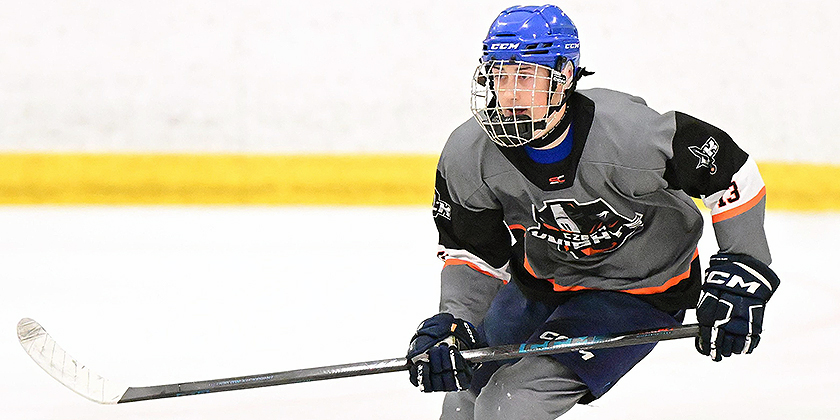
Neutral Zone attended this J18 game on September 17, 2026. In a back-and-forth game, Vaxjo and their puck possession style outlasted Rogle with an overtime win. Below are 17 reports based solely on this game.
Vaxjo
Ruben Johansson #1 (G, 6’0″, 159, 01/14/2010) – He competes hard and shows some quickness down low, particularly with his legs, while working diligently to track the puck through traffic. He has a tendency to rely heavily on quick, reactive movement, and adding more control and efficiency to his movements would help him stay more consistently balanced and square to the puck. He does a good job absorbing shots into his chest and generally limits rebounds when he can secure the puck cleanly. Positionally, however, he needs to make himself bigger in his butterfly and maintain stronger post integration, as he was frequently extended beyond the post on the short side and appeared smaller than his frame would suggest because of his stance. He has decent height but would benefit from using his size more effectively through stronger positioning and a more expansive butterfly. His puck play is currently a clear area for development, as he lacks confidence leaving the crease and rarely provides support to his defenders by handling pucks. He does show some awareness in directing pucks toward the corners when possible, but becoming more comfortable outside the crease could add another dimension to his game and help his team with breakouts. Overall, he shows good effort, puck-tracking ability, and some useful athleticism down low, but would benefit from greater movement control, stronger positioning, a bigger stance, and increased confidence in his puck handling.
Grade: C+ Athleticism/Reflexes: 3.5 Positioning/Technique: 2.75 Puck Play: 2.25 Competitiveness: 2.75 Hockey IQ: 2.75
Tomas Albrecht #17 (LW, R, 5’10”, 150, 02/05/2010) – Albrecht was a highly impactful player throughout the game, consistently influencing play with his skating, puck skill, vision, and competitiveness. He possesses excellent edge work and an effortless stride that allows him to maintain possession while attacking seams or using evasive moves to create space, with added strength likely to make his skating even more effective. His vision is a major strength, as he consistently looks before receiving the puck, understands his surroundings, and can execute touch passes in tight areas. He is particularly dangerous when attacking seams in the offensive zone, drawing multiple defenders before finding the open teammate, and showed strong creativity with an indirect pass off the wall that led to a scoring chance. With the puck on his stick, he can control play on the power play, maintain possession along the half wall through constant movement and escape turns, and redirect pucks from the high slot by finding open ice. He is capable of shooting accurately in full stride, showing a quick release on a breakaway that beat the goaltender but hit the post before redeeming himself in overtime by picking his spot and finishing another breakaway. Defensively, he competes with pace on the forecheck and uses an active stick to disrupt passing lanes. While he could add strength for board battles, he compensates with anticipation, instincts, and a quick stick to win pucks. He competes hard in all three zones and can be trusted in key situations, while his willingness to keep his feet moving and continue creating options was evident on the overtime-winning play when he emerged from a pileup with the puck. Overall, Albrecht was the difference-maker throughout the game and consistently created positive outcomes on a majority of his shifts.
Grade: A Skating: 4.25 Passing: 4.5 Shooting: 4.25 Puck Handling: 4.25 Defense: 4.0 Size/Strength: 3.75 Competitiveness: 4.25 Hockey IQ: 4.5
Ludvig Neijbert #44 (D, L, 6’0″, 170, 04/02/2010) – He is an agile, intelligent defenseman who shows good puck skills and decision-making, with room to become more impactful through increased aggression and physical strength. His skating is a positive, as he moves well and has the speed to support the play, but he needs to recognize opportunities to jump into the attack after making his initial pass rather than remaining behind the play. He makes good decisions with the puck and shows a useful sense of touch on his passes, while his creativity is particularly evident in his own end, where he is comfortable using saucer passes and reverses in tight areas to escape pressure. He demonstrates good coordination and awareness with his feet, including the ability to adjust and receive passes that are not delivered directly onto his stick. Defensively, he relies heavily on his stick to disrupt plays, but needs to maintain stronger body positioning and use his skating more effectively to close space and control opponents. Adding strength would also help him become more effective on the defensive side of the puck and improve his ability to compete in physical situations. His hockey IQ is evident in his ability to read the ice and find solutions under pressure, although he can sometimes play too cautiously when a more assertive decision could create an advantage. Overall, he is a skilled puck-moving defenseman with good skating, passing touch, and awareness who could become more effective by activating offensively with greater consistency, improving his defensive positioning, and adding strength. Grade: B- Skating: 4.0 Passing: 3.5 Shooting: NR Puck Handling: 3.75 Defense: 3.0 Size/Strength: 3.0 Competitiveness: NR Hockey IQ: 3.5
Liam Persson #55 (D, L, 5’9″, 141, 04/15/2010) – He is a composed puck-moving defenseman with a smooth stride and enough speed to create separation from the forecheck. He moves well with the puck and shows good awareness of his surroundings, particularly when exiting from behind his own net, where he understands the importance of staying in the middle of the ice rather than allowing himself to be pinned along the boards. He has quick hands and maintains control through pressure while keeping his options simple and efficient. As a passer, he shows strong cross-ice vision and the ability to execute longer stretch passes, including one that directly led to a goal. His hockey IQ is evident in his understanding of when to attack through the middle, when to make the simple pass, and when to eliminate risk by getting the puck deep if no better option is available. Overall, he is a steady, intelligent defenseman who combines smooth skating, quick hands, and effective puck management to support clean exits and transition play. Grade: B- Skating: 3.75 Passing: 4.25 Puck Handling: 3.75 Hockey IQ: 3.75
Sigge Isaksson #71 (RW, L, 5’11”, 157, 06/07/2010) – Isaksson is a left-shot defenseman who combines a powerful first stride with good agility and confidence to create separation and move the puck under pressure. He understands the importance of staying central when breaking out of his own end, giving himself options to both sides of the ice, and effectively uses his partner and the back of the net to alleviate forechecking pressure. With good hand and foot speed, he can take open ice when available while remaining ready to distribute the puck, and a well-executed fake pass while crossing the ice opened up space for a scoring opportunity. Offensively, he uses agility and puck manipulation to create lanes from the blue line but would benefit from shooting more consistently, even if the initial attempt is simply intended to generate rebounds and second-chance opportunities around the net. Defensively, he shows good instincts, an effective stick, and an understanding of how to defend zone entries, though he needs to be more disciplined with his positioning and avoid overcommitting to the outside and allowing an inside attack to develop. He can also improve his net-front coverage at times. He shows good balance and functional strength in battles, particularly when he plants his feet, and competes hard every shift while actively looking to get involved and communicating with his partner. Overall, Isaksson is an intelligent, mobile defenseman who combines skating, puck confidence, and strong transition instincts with a competitive approach.
Grade: A- Skating: 4.25 Passing: 4.25 Shooting: 3.75 Puck Handling: 4.0 Defense: 3.75 Size/Strength: 3.75 Competitiveness: 4.0 Hockey IQ: 4.25
Josef Krantz #84 (LW, L, 6’2″, 163, 02/20/2009) – He is a big, strong player who uses his size and reach effectively on both sides of the puck. While he could use another gear in his skating, he can still push defenders back by driving wide and using his frame to protect possession. He is comfortable moving the puck laterally in his own end to maintain control and shows good hockey sense in recognizing when to keep possession rather than forcing a low-percentage pass. Along the wall, he is difficult to handle and consistently wins puck battles through his size, reach, and strength. He also shows good puck skill in the offensive zone, using smooth escape turns to create space and finding ways to utilize the point once he has gained separation. Defensively, he supports the puck well down low and understands how to use his physical tools to help maintain possession and win battles. Overall, he is a strong, intelligent player who brings value through his physical presence, puck protection, and ability to make controlled decisions with the puck, while improved skating speed would help him create even more separation and offensive pressure.
Grade: B
William Landstrom #92 (RW, R, 6’5″, 198, 05/08/2009) – He is a strong, physically mature player who uses his size well to protect the puck and create opportunities, particularly when attacking from the outside. His skating still needs some refinement, but with improved edgework and added speed he could become more dangerous driving to the net from the perimeter. He can generate speed through the neutral zone by hitting seams, and he drew a penalty when he gained a step on a defender. With the puck, he does a good job protecting to the outside and using his body to shield defenders, while his size and strength allow him to win or protect possession along the wall in his own end. He can shoot in stride but would benefit from getting to better angles and improving his ability to pick his spots. His passing and hockey sense stand out on the power play, where he showed excellent anticipation by recognizing the next play before receiving the puck and executing a quality bumper pass down low that should have resulted in a goal. Defensively, he is sound and willing to use his body and strength to compete for pucks and maintain possession. He is difficult to knock off the puck and brings a physical presence, though he could improve his stamina and consistency of effort over longer shifts. Overall, he combines size, puck protection, offensive awareness, and competitiveness, with skating development representing an important area for continued growth. Grade: B Skating: 3.5 Passing: 3.75 Shooting: 3.75 Puck Handling: 3.5 Defense: 3.75 Size/Strength: 4.0 Competitiveness: 3.75 Hockey IQ: 3.75
Ludwig Persson #94 (C, L, 6’0″, 183, 02/10/2010) – He is a competitive player who works hard at both ends of the ice and brings a physical presence to his game, particularly along the defensive wall and in corner battles. He battles hard on the defensive side of the puck and is willing to put his body in to win or protect possession, showing good strength and compete in contested areas. Offensively, he has some touch and skill with his hands, but would benefit from being more willing to drive the puck to the net from the outside and attack defenders with purpose. His ability to simplify his game around the net was evident on his second goal, where he avoided overhandling the puck and got his shot off quickly in tight. That quick decision-making and release allowed him to capitalize on the opportunity. Skating remains an area for development, as he needs to add more speed and improve his edgework to become more effective creating separation and attacking with pace. Overall, he is a hard-working, physical competitor who contributes through his willingness to battle, defensive engagement, and ability to finish quickly around the net, with improved skating and a more aggressive approach to driving the puck offensively representing key areas for growth. Grade: B- Skating: 3.25 Passing: NR Shooting: 3.75 Puck Handling: 3.5 Defense: 3.75 Size/Strength: 3.75 Hockey IQ: NR
Ricky Helte #95 (D, L, 5’11”, 154, 07/23/2010) – He is an agile, mobile defenseman with good edges who uses his skating effectively to create passing and shooting lanes. He is comfortable taking open ice with the puck but consistently keeps his head up and looks to make a pass, showing good awareness of his options. He made sound puck decisions at both ends of the ice and executed his passes efficiently, helping support clean transition play. A left-handed defenseman playing on the right side, he looked comfortable on his off side and did not appear out of place handling the puck or making plays from that position. Defensively, his mobility allows him to close on loose pucks quickly in his own end and get to areas before pressure arrives. He also shows good awareness under the forecheck, using tight turns around his net to create separation and relieve pressure before making the next play. Overall, he is a mobile, intelligent defenseman who combines strong edgework, efficient puck movement, and good situational awareness to support both the defensive game and transition.
Grade: B Skating: 4.0 Passing: 3.75 Puck Handling: 3.75 Defense: 3.5 Hockey IQ: 3.75
Rogle
William Backlund #5 (D, L, 5’10”, 176, 01/22/2010) – He is a reliable two-way defenseman who moves and handles the puck effectively while providing value at both ends of the ice. He has good balance from a wide skating stance and is willing to take open ice when available, although he would benefit from adding more speed and power to his stride to become more effective in open-ice situations. With the puck, he keeps his game simple and consistently makes the easy play, while showing patience at the top of the power play and distributing when a defender commits toward him. He is also comfortable protecting the puck along the offensive-zone boards and demonstrates confidence when maintaining possession under pressure. Offensively, he is willing to activate and join the play, but would benefit from getting his shot off more quickly when moving into high-traffic areas. His activity along the offensive blue line is a positive, as he stays in motion, looks to attack the back door, and works to create passing lanes when the puck is down low. Defensively, he relies effectively on body positioning and an active stick to take away time and space, with his strongest work currently coming along the boards. Improved skating and added physical power would help him defend more effectively in open ice and add more strength to his overall game. His hockey IQ is evident in his understanding of when to protect possession, make the simple play, and remain active as an offensive support option. Overall, he is a dependable defender with sound puck management and positioning who can become more impactful with improvements in skating speed, stride power, and physical strength.
Grade: B Skating: 3.5 Passing: 3.75 Shooting: 3.0 Puck Handling: 3.75 Defense: 3.75 Size/Strength: 3.5 Competitiveness: 3.5 Hockey IQ: 3.75
Ebbe Gath #14 (C, R, 6’0″, 168, 12/13/2009) – He is a strong, versatile forward who brings size, puck protection, and a good understanding of the game to a variety of situations. He has good straight-line strength but would benefit from adding more edge work and agility to improve his overall mobility and ability to change direction. He plays the bumper effectively in a 1-3-1 power-play setup and consistently appears to know his next play before receiving the puck, allowing him to move possession efficiently. He has a good feel for finding open space in the offensive zone, although he needs to get his shot off more quickly when opportunities develop. His soft hands allow him to handle the puck effectively in traffic, while his ability to use his body to protect possession along the boards adds value in contested situations. Defensively, he provides physical support down low and uses his size effectively to battle around the net. That size is particularly valuable offensively, where he can establish an imposing net-front presence and create screens and traffic when the puck is at the blue line. He competes hard on the forecheck and uses his long reach to take away space, pressure defenders, and disrupt their options. His hockey IQ is evident in his ability to contribute in numerous situations and understand his responsibilities on both sides of the puck. With improved skating, particularly through added agility and edge work, he has the potential to become a more impactful player by allowing his size, hands, awareness, and competitiveness to translate more consistently throughout the ice.
Grade: B Skating: 3.25 Passing: 3.75 Shooting: 3.25 Puck Handling: 4.0 Defense: 3.75 Size/Strength: 3.75 Competitiveness: 3.75 Hockey IQ: 3.5
Sixten Johansson #29 (D, R, 6’0″, 165, 02/24/2010) – He is a composed defenseman who moves well through transitions and shows good poise with the puck in all three zones. He pivots effectively and transitions smoothly from forward to backward skating, allowing him to maintain control and stay connected to the play. With the puck, he keeps his head up and is willing to use the middle of the ice, while his ability to make a long pass while skating backward has helped create transition opportunities. He is calm and confident when handling the puck in the neutral zone, including while skating backward, which gives his forwards time to regroup and allows him to make more controlled decisions. His shooting is effective at getting pucks through to the net, and he was rewarded with a goal off a faceoff by getting the puck away quickly and putting it on target, even if the goaltender would have been expected to make the save. Defensively, he relies primarily on positioning and his stick to disrupt plays, but would benefit from becoming more physical along the boards and adding strength for one-on-one battles, particularly below his own goal line. He provides a consistent effort but could become more involved offensively, especially around the offensive blue line. His hockey IQ is evident in his calm puck management, effective first passes, and understanding of when not to force the puck through high-traffic areas. He also communicates well with his defensive partner when switching sides, recovering into position, or preparing to change. Overall, he is a steady, intelligent defenseman who makes sound decisions with the puck and could become more effective with added strength, physical engagement, and offensive involvement.
Grade: B Skating: 4.0 Passing: 3.75 Shooting: 3.5 Puck Handling: 3.75 Defense: 3.5 Size/Strength: 3.5 Competitiveness: 3.5 Hockey IQ: 3.75
Ozcar Zimmerlund #45 (G, 6’1″, 187, 04/08/2011) – He provided a calming presence in the crease and was a major reason Rögle remained within reach despite being put in difficult situations by turnovers that led to several breakaway goals. He moves quickly from post to post and generates strong lateral push to challenge shooters in the slot, while his strong glove hand gives him another reliable tool on incoming shots. Technically, he remains controlled within his posts, stays square to the puck, and maintains a strong position down low. He does a good job keeping rebounds in front of himself when necessary and shows good awareness of when to direct pucks safely toward the corners or take a whistle to settle play. He is comfortable playing at the top of his crease to challenge shooters and uses a strong butterfly position to stay big and take away available net. His puck play is limited, as he rarely leaves the crease to handle the puck, but he contributes to controlling the tempo through timely whistles and sound rebound management. Competitively, he remains composed while tracking the puck well and using his eyes to anticipate developing passes and surrounding threats. He also showed the ability to deliver in a key moment, making an important breakaway save with his team leading 2-1. Overall, he displayed solid technical control, strong crease positioning, quick lateral movement, and good composure, while his rebound management and ability to challenge shooters helped keep his team in the game.
Grade: A- Athleticism/Reflexes: 4.0 Positioning/Technique: 4.25 Puck Play: 2.75 Competitiveness: 3.75 Hockey IQ: 4.0
Viktor Almtorp #52 (D, R, 6’5″, 194, 06/13/2009) – He is a big right-shot defenseman who shows some smoothness with the puck but would benefit from improved skating speed, agility, and overall physical strength to take his game to the next level. His skating has enough fluidity to support his puck skills, but he needs to add more pace and power to his stride while keeping his feet moving consistently to maintain optimal defensive positioning. On the power play, he shows good intentions and awareness at the top, but needs to become more decisive with his puck movement and commit to his passing options more quickly. His confidence with the puck remains an area for improvement, as there were situations where he chose to dump the puck rather than maintain possession, including consecutive dump-ins late in a close game when his team needed to generate offense. He also struggled to adjust quickly when passes were not delivered directly to him, with a puck-handling miscue contributing to a shorthanded breakaway against. Defensively, his long reach gives him the ability to disrupt opposing players and take away space, but he needs to combine that reach with better foot movement and body positioning. His size is an asset, particularly as a right-shot defenseman, but adding strength to his frame and stride would help him make better use of his physical tools. Competitively, he would benefit from playing with more urgency and using his size more consistently to impose himself in battles. His hockey sense is evident in his ability to see developing plays, but he needs to anticipate situations sooner and react more quickly. Overall, he has useful size, reach, and puck skills, with improved skating, strength, decisiveness, and competitiveness offering clear opportunities for growth.
Grade: B- Shooting: NR Competitiveness: 3.5
Vitus Plank #58 (RW, R, 6’2″, 179, 10/22/2009) – He is a big, powerful forward who combines straight-line speed, strong puck protection, and good offensive awareness, with the tools to be effective in a variety of situations. He can generate speed by attacking seams through the neutral zone, although he needs to maintain his original line more consistently rather than cutting back and sacrificing momentum. He has soft hands for a power forward and sees the ice well enough to make useful plays with the puck. He is strong on his stick and protects possession effectively with his body, making it difficult for defenders to separate him from the puck. Offensively, he has a tendency to shoot from the outside and would benefit from improving his ability to pick shooting spots or use low-percentage attempts to intentionally create rebounds. His size and straight-line speed give him the potential to be more dangerous when he commits to driving the puck toward the net rather than settling for perimeter opportunities. Defensively, he needs to become more consistently involved in his own zone and rely more on his physical presence rather than attempting to defend primarily with his stick. His competitiveness was evident on an excellent backcheck where he disrupted a breakaway following a miscommunication on an offensive-zone faceoff. His hockey IQ is a clear positive, as he understands the game well, can be trusted in numerous situations, and shows awareness in details such as using his shoulder during puck races to establish inside position. He also demonstrates good net-front understanding, keeping his stick available in front of his body to remain prepared for deflections rather than allowing it to become tied up. Overall, he has a strong physical and skill foundation, and his game could take another step forward by consistently using his size and speed to attack the interior, maintaining momentum through the neutral zone, and becoming more engaged defensively. Grade: B+ Skating: 3.75 Passing: 3.5 Shooting: 3.5 Puck Handling: 4.0 Defense: 3.25 Size/Strength: 4.0 Competitiveness: 4.0 Hockey IQ: 4.0
Vide Forsmark #65 (D, L, 5’10”, 146, 03/29/2009) – He is a mobile, reliable two-way defenseman who combines good agility, a powerful first stride, and sound decision-making to contribute effectively at both ends of the ice. He has a strong first step when transitioning from defense to offense, allowing him to quickly join the attack when opportunities open. With the puck, he keeps his head up and plays with a pass-first mentality, consistently making the simple play and moving possession efficiently rather than forcing unnecessary chances. He also shows good awareness of when to activate into the offensive play and when to simply get the puck deep to maintain possession and pressure. His shooting can provide an additional element, as demonstrated by his goal on a quick shot to the net, although the goaltender mishandled the attempt. Defensively, he competes with commitment and attention to detail, communicating effectively with backchecking forwards to establish coverage and using proper pinning technique to control opponents below the goal line. He is willing to sacrifice his body to make defensive plays, including sprawling to block a shot late in the game. His low center of gravity provides good strength along the defensive walls and helps him maintain leverage in battles. He plays a consistent game at both ends of the ice and demonstrates a dependable understanding of his responsibilities. Overall, he is a steady, mobile puck-moving defenseman who makes smart decisions, supports the attack when appropriate, and brings a competitive, team-oriented approach to his defensive responsibilities.
Grade: B Skating: 4.0 Passing: 4.0 Shooting: 3.25 Puck Handling: 3.75 Defense: 3.75 Size/Strength: 3.5 Competitiveness: 3.75 Hockey IQ: 3.75
Photo Credit: Dan Hickling