
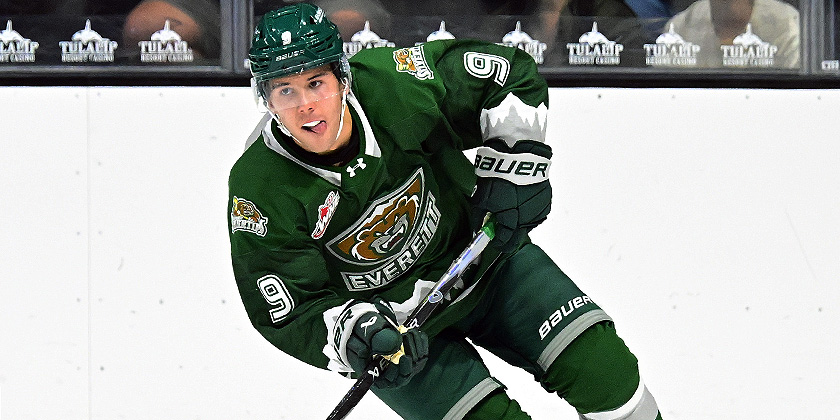
October marks the start of the NCAA ice hockey season so here at Neutral Zone we will give a full-scale analysis of this year’s incoming prospects, teams incoming classes and where the trends are in the NCAA recruiting landscape. Overall, this year’s recruiting class cycle gives us insight into the future of college hockey. First, CHL rule change is not only significant but their influence is growing, nearly 50% uptick in CHL committed prospects this class as opposed to last year’s NCAA Recruiting Class. The Transfer Portal is not as significant as the NCAA Freshman recruiting, but it is still impactful as over 180 players landed a new D1 home and some teams made up significant ground with transfers. Lastly, this class shows that the incoming freshman are better than years past and slightly younger which will be an encouraging trend for the quality of hockey at the NCAA D1 level.
CHL Impact on the 2026-2027 Freshman Class
On November 7th, 2024 the NCAA changed its historical rules against CHL players being able to participate in NCAA which immediately changed the NCAA ice hockey recruiting landscape. The 2024-2025 season had no CHL players but that very next season just over 1/3 of all NCAA D1 freshman came from the CHL; a remarkable change in the first year of adoption.
One of the questions heading into this recruiting class was the influx of CHL players going too slow, was it going to remain the same or was it going to increase? There we some hints throughout the season; generally speaking the CHL freshman through the first two months of the season were having the largest impact measured by games played and minutes played but we ran an analysis at the end of the year of the All-Freshman award winners in each conference (https://neutralzone.com/2026/03/24/ncaa-freshman-analysis/). Here we saw that over half the All-Freshman teams throughout the NCAA D1 landscape were coming out of the CHL so it wasn’t surprising when NCAA programs placed higher priority in their second year of having this available.
The result? A 50% increase in CHL recruiting as CHL prospects made up just shy of half this year’s NCAA D1 recruiting class. This is even more prevalent at the top ranked programs as CHL alumni make up nearly two-thirds of the top 10 recruiting classes. Most notably the top three classes: Michigan State (78%), Michigan (100%) and Denver (88%).
Top Ranked Freshman Recruiting Classes (Quality vs. Aggregate)
NCAA recruiting classes can be ranked in one of two ways; aggregate or quality. The aggregate is the most standard rating system because it truly measures the likely impact that class will have in relationship to the rest of the team. This means if the school has 26 players on the roster and 16 come from the freshman class, it is likely that class will, in aggregate, represent over 50% of the teams minutes played and points scored, etc. With that said, just because a team has a large class – doesn’t necessarily mean it’s the best class. Therefore we do a quality rating as well which takes the average star ratings of the incoming class. That can also be misleading because a class that brings in 4 players who are outstanding; while those four players are likely to have a lot of success, the overall impact of the freshman class as it relates to the team is limited given that there are so few of them, they could represent less than 20% of the roster.
Top 10 NCAA Recruiting Class Freshman (Aggregate)
| Rank | Team | Conference | # of Commits | Points |
| 1 | Michigan State | Big 10 | 9 | 961.81 |
| 2 | Denver | NCHC | 8 | 881.8 |
| 3 | Michigan | Big 10 | 7 | 864.07 |
| 4 | Boston College | Hockey East | 11 | 852.13 |
| 5 | UMass Amherst | Hockey East | 11 | 801.8 |
| 6 | North Dakota | NCHC | 10 | 765.23 |
| 7 | Nebraska Omaha | NCHC | 10 | 745.43 |
| 8 | Penn State | Big 10 | 9 | 727.4 |
| 9 | Arizona State | NCHC | 9 | 712.67 |
| 10 | Lake Superior | CCHA | 13 | 711.14 |
The aggregate rankings is based on an algorithm of historical data that assigns values to the league strength of where the players come out of, their age and their star rating.
Top 10 NCAA Recruiting Class Freshman (Quality)
| Rank | Team | Conference | # of Commits | Star Average |
| 1 | Michigan | Big 10 | 7 | 4.43 |
| 2 | Denver | NCHC | 8 | 4.41 |
| 3 | Michigan State | Big 10 | 9 | 4.33 |
| 4 | Notre Dame | Big 10 | 4 | 4.31 |
| 5 | Boston University | Hockey East | 6 | 4.25 |
| 6 | Minnesota Duluth | NCHC | 5 | 4.15 |
| 7 | Western Michigan | NCHC | 7 | 4.14 |
| 8 | Penn State | Big 10 | 9 | 4.14 |
| 9 | Boston College | Hockey East | 11 | 4.14 |
| 10 | Minnesota | Big 10 | 8 | 4.13 |
There are multiple angles to take from this data but the overlap of the top three classes, Denver, Michigan State and Michigan is obvious that in this cycle those three stand alone in both ratings with Boston College and Penn State also with top 10 finishes in both.
On the aggregate side there are some schools who have made significant progress in this cycle; Lake Superior jumps out as a program who has made a significant investment into NIL and recruiting and picked up 13 quality prospects in this cycle. Ferris State under new coach Brett Riley came in at #11 on the aggregate rating also picking up 13 prospects and significantly improving their roster.UMass Amherst at #5 and Nebraska Omaha (#7) are programs who have brought in both large classes and also had star rating averages over 4.0; not an easy feat.
On the quality ratings we see some teams who are not in the Top 10 (or even top 25) in aggregate ratings like Notre Dame, Boston University, Minnesota-Duluth and Western Michigan who are strong in quality but just have smaller classes of 4, 6 and 5 and 7 respectively.
From an overall perspective, the NCAA freshman recruiting classes are getting stronger; not only at the top of the curve with elite NHL Draft talent coming into the league but also in its depth of talent.
Comparing this recruiting class to historical recruiting class data (prior to the rule change), in 2024 for example Penn State had the 10th ranked freshman recruiting class with a total of 589 points. Just two years later 589 points (aggregate ratings) wouldn’t land a team in the Top 20. From a quality perspective two years ago the 2024 NCAA Recruiting Rankings had just six teams in total with a star rating average above 4.0; this year’s recruiting class has 16.
What does this data tell us? College hockey is getting better.
Deeper Look into NCAA Recruiting Trends
Age of Freshman
The historical average age is falling slightly as less than 50% of the incoming freshmen were 20-year-old age out junior players. That is a number that is going to be interesting to follow in the coming years as there is potential legislation that will change the eligibility of prospects who are enrolling after the age of 19. However, it’s worth noting that before that potential rule change- the recruiting trends are going slightly younger. It is also true that the majority of prospects that are enrolling in NCAA D1 programs, over 80%, are going to be 20 or 21 as freshmen.
| Birth Year | # of Players | % |
| 2005 | 240 | 47.81% |
| 2006 | 169 | 33.67% |
| 2007 | 68 | 13.55% |
| 2008 | 24 | 4.78% |
| 2009 | 1 | 0.20% |
We see a 2009 in Landon Dupont coming into college hockey which is extremely rare but he’s the only 5-star prospect in the class. In fact, he’s the first five-star rated prospect since NHL star Macklin Celebrini enrolled at Boston University.
League of Origin
This chart shows where the player pool is coming from on a league by league basis. The United States Hockey League is still the top producer of NCAA freshman coming in at nearly 27% of this freshman class. It’s also worth noting that this is the lowest it has been since NZ’s founding in 2016, as it’s typically in the 40%+ range. The NTDP is another group that saw a drop as only six players off their 2025-2026 NTDP U18s roster are enrolled into NCAA D1 hockey this season.
| League | # of Players | % |
| OHL | 83 | 16.53% |
| QMJHL | 58 | 11.55% |
| WHL | 97 | 19.32% |
| USHL | 134 | 26.69% |
| NTDP | 6 | 1.20% |
| NAHL | 45 | 8.96% |
| BCHL | 59 | 11.75% |
| Other | 21 | 4.18% |
The CHL now represents 47% of this freshman class and that is a notable increase from the year prior. The other significant area to keep on eye on is Canadian junior hockey (CHL, BCHL, AJHL, etc) has outpaced the American junior hockey (USHL, NTDP, NAHL) by over 100 players or 60% vs. 38%. That is more nuanced than it may look as there has been a considerable increase in American prospects going to Canada for junior hockey in the past two years so that doesn’t mean Canadians are outpacing US players in this cycle – it’s just referring to the leagues they are coming to college hockey from.
Talent Quality
The quality of talent is on the rise in college hockey and it can be seen in the Star Rating data. While there are just 12 prospects in the 4.75 or 5.0 star range in this cycle that is nearly double the historical average. The most obvious group that has jumped is the 4.5 and 4.25 star prospects who now represent over 15% of the incoming talent – which is again, is up nearly 70% from its historical average. The 4.0 and 3.75 contingent is the bulk of college hockey – they are nearly 60% of the total population and these are high quality prospects who are scholarship-level players, likely undrafted in the NHL but are among the better players in junior hockey. This contingent are the core of most teams, they play for 3 or 4 years and they might not be immediate top six contributors as freshman but they are typically the leaders on the team down the road.
| NZ Rating | # of Players | % |
| 5 | 1 | 0.20% |
| 4.75 | 11 | 2.19% |
| 4.5 | 18 | 3.59% |
| 4.25 | 62 | 12.35% |
| 4 | 113 | 22.51% |
| 3.75 | 175 | 34.86% |
| 3.5 | 101 | 20.12% |
| > 3.5 | 21 | 4.18% |
Deeper Look into NCAA Recruiting Classes – Strategies
The NCAA landscape – especially post NIL – has become even more fragmented. You have teams that are well-funded and provide scholarships and NIL opportunities (Michigan, Michigan State, Wisconsin, etc.) and you have other schools who are unable to grant scholarship and don’t participate in NIL (Harvard, Dartmouth, Princeton, etc). WIth that being said, each league, each team, each situation is slightly different and will deploy different recruiting strategies.
The Top 3 – Recruiting for Talent
The Top 3 classes, Denver – Michigan State and Michigan went in a similar direction in that they are highly focused in the CHL as 20 out of their 24 recruits (83%) are coming from the CHL. Despite that Michigan State went slightly older this year with only two 2008’s where Denver went a bit younger with four. These schools have a combined average star rating of 4.37 Stars which shows the caliber of hockey player they are getting in this class.
Big and Diverse Classes
There are a lot of teams that fit this category but to point out a few good examples it’s North Dakota, UMass Amherst, Boston College. All of these schools took big classes, 10+ and they fill multiple roles. North Dakota will be a tougher team to play against with this class – they brought in a good mix of size, age and headlined by Carson Carels on the backend who could end up being one of the best defenseman in college hockey. Boston College went with a more local US strategy taking 6 of their 11 out of the USHL and NTDP and are older in this class then they have been historically. UMass Amherst is balanced – they brought in arguably the best goalie commit in this cycle in Tobias Trejbal and they have ages from 2005s to 2008s, they have size, they have skill, they have highly competitive guys – it’s a great mix.
Lake Superior and Ferris State are both programs who have found their way into the top quarter of NCAA recruiting classes, which is not common at those schools, with big hauls of 13 players each. Both have been diverse, getting players from CHL (50%) but also USHL, BCHL, NAHL, and European leagues.
Highly Concentrated CHL
Aside from the top three (Michigan St, Denver and Michigan) there is also: Nebraska Omaha (80%), Penn State (89%), UConn (78%), Western Michigan (71%), Quinnipiac (86%), Clarkson (86%), Northeastern (75%). These are just some schools in the top half of the Recruiting Class Rankings who have made CHL a concentration and are committing a high percentage of their players.
Highly Concentrated US / USHL
Miami-Ohio (70%), Wisconsin (100%), Union (71%), Yale (71%), Brown (86%). Wisconsin has gone against the grain in this cycle and gone completely in the US market with two out of the NAHL and six out of the USHL and still landing a top 25 class. Miami-Ohio, whose coach was a longtime head coach in the USHL, has doubled down in that league and committed seven of his nine incoming freshmen out of the league and getting rewarded with a top 25 ranked class.
Small Class but Mighty
Boston University, Notre Dame and Minnesota Duluth. These three schools have a combined recruiting class haul of 15 players and the average star rating is 4.22. These might not be deep classes but they have real talent; BU is led by Caleb Malhotra who will likely be one of the best two-way forwards in college hockey this season; Notre Dame has Sammy Nelson who has a real chance at being a Top 10 NHL Draft Pick and Minnesota Duluth bring in another Plante this time Victor who was drafted by Detroit this past year out of NTDP.
Size Matters
Of the Top 5 recruiting classes only 21% of the prospects are listed at under 6 feet tall. It climbs up to over 30% when including the top 15 ranked programs but the overall concept that college and pro hockey is faster and more skilled and therefore size isn’t as relevant…..the numbers don’t bear that out.
The Top 30 Freshman Prospects
There is a difference between a prospect and a player although that term gets confused often in media circles. We outline the Top 30 prospects as gauged by star ratings – however it is important to note that these are not necessarily the top 30 impact players in this freshman class. What is that? Part of the answer is that star ratings are a relative rating to the players birth year – so elite level (4.5+ star rated) prospects that are 2005’s and 2006’s are likely in the NHL already or juniors and seniors in college hockey. So a 21 year old freshman this season who is a 4.0 star prospect is not necessarily inferior today to a 4.5 star 18 year-old. The 4.5 star player has a higher ceiling, he’s three years younger and is a better prospect – but not necessarily a better “player” today.
The other factor besides star rating is opportunity. Michigan State is a prime example of a team that has Cullen Potter, Ryker Lee and Cayden Lindstrom – all with NCAA experience and highly rated prospects. So despite the talent level and long term upside of their incoming freshman forwards like Mason West, Jack Hextall and Ethan Belchetz are not likely to be featured – at least right away – like some other freshman in this class who are ranked lower but are playing on weaker teams.
Here is a list of the top 30 prospects by star rating (alphabetic by first name) who are 4.5 star rated prospects and above.
| Name | Pos | Juniors | League | Birth Year | School | Rate |
| Landon DuPont | D | Everett Silvertips | WHL | 2009 | Michigan | 5 |
| Caleb Malhotra | C | Brantford Bulldogs | OHL | 2008 | Boston University | 4.75 |
| Cameron Reid | D | Kitchener Rangers | OHL | 2007 | Michigan | 4.75 |
| Carson Carels | D | Prince George Cougars | WHL | 2008 | North Dakota | 4.75 |
| Chase Reid | D | Soo Greyhounds | OHL | 2007 | Michigan State | 4.75 |
| Daxon Rudolph | D | Prince Albert Raiders | WHL | 2008 | Denver | 4.75 |
| Ethan Belchetz | LW | Windsor Spitfires | OHL | 2008 | Michigan State | 4.75 |
| Jack Nesbitt | C | Windsor Spitfires | OHL | 2007 | Michigan | 4.75 |
| JP Hurlbert | C | Kamloops Blazers | WHL | 2008 | Michigan | 4.75 |
| Ryan Lin | D | Vancouver Giants | WHL | 2008 | Denver | 4.75 |
| Sammy Nelson | LW | USA NTDP U18 | NTDP | 2008 | Notre Dame | 4.75 |
| Wyatt Cullen | LW | USA NTDP U18 | NTDP | 2008 | Minnesota | 4.75 |
| Adam Benak | C | Brantford Bulldogs | OHL | 2007 | Western Michigan | 4.5 |
| Beckham Edwards | C | Sarnia Sting | OHL | 2008 | Notre Dame | 4.5 |
| Blake Fiddler | D | Edmonton Oil Kings | WHL | 2007 | Denver | 4.5 |
| Haoxi Wang | D | Niagara Icedogs | OHL | 2007 | Boston University | 4.5 |
| Jack Hextall | C | Youngstown Phantoms | USHL | 2008 | Michigan State | 4.5 |
| Jacob Kvasnicka | RW | Penticton Vees | WHL | 2007 | Minnesota | 4.5 |
| Joshua Ravensbergen | G | Prince George Cougars | WHL | 2006 | Michigan State | 4.5 |
| Luke Schairer | D | USA NTDP U18 | NTDP | 2008 | Boston College | 4.5 |
| Mason West | RW | Portland Winterhawks | WHL | 2007 | Michigan State | 4.5 |
| Mikey Berchild | C | USA NTDP U18 | NTDP | 2008 | Denver | 4.5 |
| Nathan Behm | C | Kamloops Blazers | WHL | 2007 | Arizona State | 4.5 |
| Niklas Aaram-Olsen | LW | Orebro HK | SHL | 2008 | Boston University | 4.5 |
| Ryder Fetterolf | G | Ottawa 67s | OHL | 2008 | Penn State | 4.5 |
| Tarin Smith | D | Everett Silvertips | WHL | 2006 | Minnesota | 4.5 |
| Tobias Trejbal | G | Youngstown Phantoms | USHL | 2007 | UMass Amherst | 4.5 |
| Tommy Bleyl | D | Moncton Wildcats | QMJHL | 2007 | Michigan State | 4.5 |
| Victor Plante | LW | USA NTDP U18 | NTDP | 2008 | Minnesota Duluth | 4.5 |
| Xavier Villeneuve | D | Blainville-Boisbriand Armada | QMJHL | 2007 | Boston University | 4.5 |
This cohort – the top echelon of prospects – only represents about 6% of this incoming class but it’s arguably the most important. The trends in this cohort are different than the national trends but they historically have been a signal for where recruiting is headed.
For example, 90% of this cohort are 2007’s (40%) and 2008’s (50%). There are zero players in the 2005s and only two in the 2006s.
Also notable, 22 of the 30 (73%) are coming out of the CHL, 5 from NTDP (16%) and 2 from USHL (6%) and 1 from SHL (3%).
If comparing these prospects to the 2024 Recruiting Class (the last class before the NCAA Rule Change) there were just 18 prospects that were 4.5 stars or above which is an increase of 66.67% in just two years time.
Impact of the NCAA Transfer Portal
Given the NCAA rule change to allow NCAA D1 prospects to transfer schools without having to sit out a season has had a major impact on how teams acquire talent. Prior to this, freshman recruiting classes were the full story and now it must be combined with the portal to get a true picture of what a teams incoming new talent looks like.
The portal is a bit of the wild west in regards to strategy. There are teams like Arizona State, who have the highest aggregate portal rankings bringing in 10 prospects but the reason they brought in 10 prospects is because they lost almost their entire roster to graduation or the transfer portal this off-season. So good on Arizona State to grab some quality replacements and rebuild the classes they lost – but net net Arizona State lost more in the portal than they acquired so their top ranking in the aggregate is nuanced.
Same as the freshman class rankings we look at both aggregate and quality.
Top 10 Transfer Portal Classes (Aggregate)
| Rank | School | Conference | # of Transfers | Points |
| 1 | Arizona State | NCHC | 10 | 683.13 |
| 2 | Minnesota | Big 10 | 5 | 524.21 |
| 3 | Maine | Hockey East | 8 | 503.21 |
| 4 | Ferris State | CCHA | 7 | 413.42 |
| 5 | Notre Dame | Big 10 | 4 | 387.54 |
| 6 | Canisius | Atlantic | 7 | 346.49 |
| 7 | Alaska Fairbanks | Independent | 7 | 334.5 |
| 8 | New Hampshire | Hockey East | 6 | 328.27 |
| 9 | Sacred Heart | Atlantic | 6 | 326.83 |
| 10 | North Dakota | NCHC | 4 | 300.58 |
Minnesota is probably the biggest winner in regards to having a coaching change and brining in 5 impact players right away with experience and will fill specific roles. Maine brought in a big portal class – there are players from Big 10 and NCHC who have upside and a player like Lee Parks out of UMass Lowell who is a great fit for how they like to play. Ferris State another big class here and complimented their strong freshman class with some experience and players coming out of big programs and being coached by some of the best in college hockey. Notre Dame is like Minnesota in that they filled specific needs and upgraded their locker room with guys who can come in and play big minutes immediately.
Top 10 NCAA Transfer Portal Rankings (Quality)
| Rank | School | Conference | # of Transfers | Star Average |
| 1 | Connecticut | Hockey East | 1 | 4.25 |
| 2 | Providence | Hockey East | 1 | 4.25 |
| 3 | Penn State | Big 10 | 2 | 4.25 |
| 4 | Minnesota | Big 10 | 5 | 4.2 |
| 5 | Wisconsin | Big 10 | 3 | 4.17 |
| 6 | Western Michigan | NCHC | 2 | 4.13 |
| 7 | Michigan State | Big 10 | 3 | 4.08 |
| 8 | Notre Dame | Big 10 | 4 | 4.06 |
| 9 | Colorado College | NCHC | 1 | 4 |
| 10 | Ohio State | Big 10 | 3 | 4 |
One could make an argument that this is the more important measurement in the transfer portal. The logic is that if you need a lot of players in the portal than it means you probably aren’t returning a lot. In some of these cases teams were able to fill important holes and/or upgrade at positions of need. UConn and Providence only took one player each but in both cases those players have a chance to be difference-makers for those teams. Penn State brings in two players out of Hockey East that will upgrade their team skill right away. The next five in our view are the teams who will get the most impact out of the portal and it starts with Minnesota.
Minnesota was looking to change it’s identity and all of these five transfers play the game the right way, they all come in with quality experience at good programs and they are all ranked 4.0 stars or higher. Wisconsin added one of the best goalies in the country in Alexis Cournoyer and one of the best forwards in the portal in JJ Weibusch – both of those hauls will have a major impact on this team as well as defenseman Dylan Compton. Michigan State locked down Cullen Potter which many believe was the best player in the portal, Notre Dame added key pieces from big time programs in the likes of Leo Gruba (Minnesota) and Hagen Burrows (Denver) who will contribute right away and Western Michigan picks up one of the top goalies in the class in Quentin Miller (Denver) and one of the top offensive defenseman in ECAC in Michael Neumeier.
Overall , there were under 200 prospects who transferred and the largest class was Arizona State at 10 and there were several teams in the country who didn’t take a single player in the portal. It is not quite at the level of importance as the NCAA Freshman Recruiting Classes but it is still impactful.
Combined Rankings (Aggregate)
| Combined Rank | Team | Conference | Freshman Rank | Portal Rank | Combined Points |
| 1 | Arizona State | NCHC | 9 | 1 | 1,395.80 |
| 2 | Michigan State | Big 10 | 1 | 13 | 1,249.62 |
| 3 | Minnesota | Big 10 | 12 | 2 | 1,194.17 |
| 4 | Ferris State | CCHA | 11 | 4 | 1,120.62 |
| 5 | North Dakota | NCHC | 6 | 10 | 1,065.81 |
| 6 | Lake Superior | CCHA | 10 | 12 | 1,003.61 |
| 7 | Penn State | Big 10 | 8 | 23 | 936.42 |
| 8 | Denver | NCHC | 2 | 54 | 929.15 |
| 9 | UMass Amherst | Hockey East | 5 | 41 | 924.75 |
| 10 | St. Cloud | NCHC | 14 | 17 | 895.39 |
This is a calculation of the teams aggregate Freshman Class Ranking + aggregate Portal Class Ranking. This tends to skew a bit for teams that brought in more players, as all of these teams on the list have over 10+ players incoming between portal and freshman class and Arizona State has 19, Ferris State has 20 and Lake Superior has 18. So those are teams who have basically rebuilt their roster with new players in this cycle.
Combined Rankings (Quality)
| Combined Rank | Team | Conference | Freshman Rank | Portal Rank | Star Average |
| 1 | Michigan | Big 10 | 1 | – | 4.43 |
| 2 | Denver | NCHC | 2 | 39 | 4.33 |
| 3 | Michigan State | Big 10 | 3 | 7 | 4.27 |
| 4 | Notre Dame | Big 10 | 4 | 8 | 4.19 |
| 5 | Penn State | Big 10 | 8 | 3 | 4.16 |
| 6 | Boston University | Hockey East | 5 | 21 | 4.16 |
| 7 | Minnesota | Big 10 | 10 | 4 | 4.15 |
| 8 | Western Michigan | NCHC | 9 | 6 | 4.14 |
| 9 | Boston College | Hockey East | 7 | 56 | 4.08 |
| 10 | Minnesota Duluth | NCHC | 6 | 17 | 4.07 |
The quality rating tends to lean heavily on the freshman recruiting classes because that is where there is higher volume. Michigan for example didn’t take anyone out of the transfer portal and landed the top quality class in the country; Denver brought in just one player and ranked #39 in portal rankings yet is 2nd in quality ratings. This is a more accurate depiction of the teams getting the best prospects.
Photo Credit: Dan Hickling/Hickling Images